Quick Takeaways
A Talent Intelligence Platform centralizes workforce capability data and transforms it into actionable insights for talent development, workforce planning, and business growth.
- A Talent Intelligence Platform turns workforce data into business insights.
- The best platforms connect competency management, skill gaps, succession, and workforce planning.
- Growing organizations should choose solutions that scale with future workforce needs.
What Is a Talent Intelligence Platform?
Many organizations have HR data spread across multiple systems.
Employee records live in the HRIS.
Performance reviews are stored in spreadsheets.
Competency frameworks sit in PowerPoint files.
Training plans are managed in separate documents.
Succession planning often exists in yet another spreadsheet.
Each system contains part of the story.
But none of them answers the questions that matter most.
Is our workforce ready for the company’s next stage of growth?
Who is ready to step into critical leadership roles?
Should we hire externally or invest in developing internal talent?
This is the gap that a Talent Intelligence Platform is designed to fill.
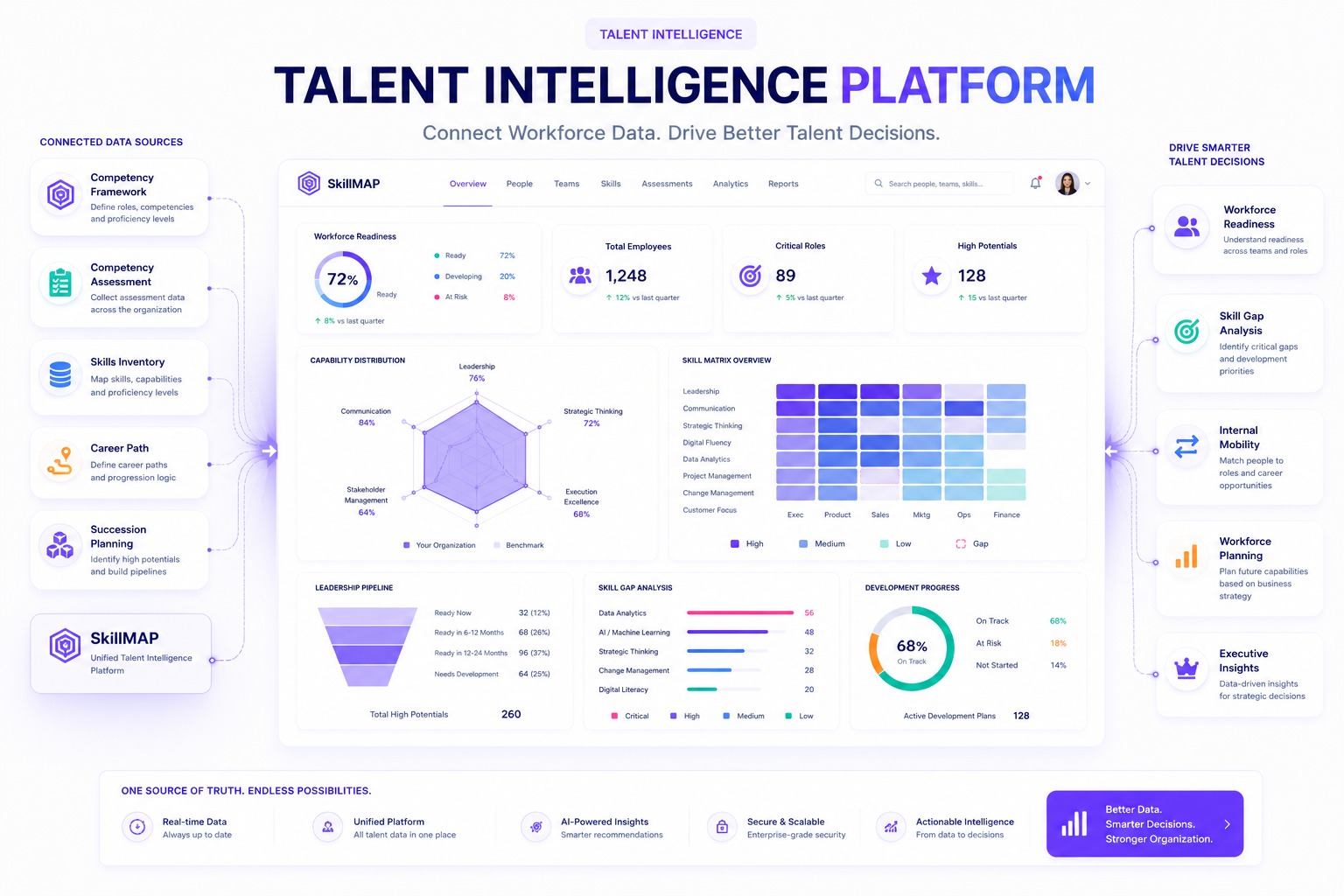
A Talent Intelligence Platform centralizes workforce capability data—including competencies, skills, performance, and readiness—and transforms it into actionable insights that support better business decisions.
How Is a Talent Intelligence Platform Different from an HRIS or ATS?
Organizations often assume these systems serve the same purpose.
They don’t.
| HRIS | ATS | Talent Intelligence Platform |
|---|---|---|
| Employee records | Recruitment management | Workforce capability management |
| Payroll, leave, contracts | Candidate pipeline | Competencies, skills, readiness |
| HR operations | Talent acquisition | Talent strategy |
| Administrative focus | Hiring focus | Workforce development focus |
These systems complement each other rather than compete.
An HRIS manages employee information.
An ATS manages hiring.
A Talent Intelligence Platform helps organizations understand and develop the people they already have.
7 Features Every Talent Intelligence Platform Should Have
1. Competency Framework Management
Every talent decision starts with a common language.
A modern platform should allow organizations to build and manage structured Competency Frameworks across different roles.
Without standardized competencies, assessment data quickly becomes inconsistent.
2. Standardized Competency Assessments
Reliable workforce data requires reliable assessments.
A Talent Intelligence Platform should support:
- Self-assessments
- Manager assessments
- Multi-rater feedback
- Calibration workflows
This creates objective capability data instead of subjective opinions.
3. Skills Inventory Visualization
Collecting data isn’t enough.
Organizations need visibility.
A platform should answer questions such as:
- Who has which skills?
- Which departments have capability gaps?
- Where are our strongest talent pools?
This is exactly what a Skills Inventory is designed to provide.
4. Automated Skill Gap Analysis
Once organizations know what capabilities exist, the next step is identifying what is missing.
A strong platform should automatically support Skill Gap Analysis by highlighting:
- Missing capabilities
- Priority development areas
- Critical workforce risks
The goal isn’t simply displaying data.
It’s generating actionable insights.
5. Career Path and Internal Mobility Support
Talent Intelligence isn’t only about assessment.
It’s about development.
The platform should help organizations build transparent Career Paths while supporting Internal Mobility initiatives that maximize internal talent before hiring externally.
6. Workforce Readiness Tracking
Business strategies evolve.
Workforce capabilities must evolve as well.
Through Workforce Readiness tracking, organizations can understand whether today’s workforce is prepared for tomorrow’s business goals.
Instead of reacting to capability shortages, leaders can anticipate them.
7. Workforce Planning and Succession Planning
Talent Intelligence Platforms should support strategic workforce decisions—not just HR operations.
That includes helping organizations:
- Build Workforce Planning strategies
- Monitor Succession Planning
- Forecast future capability requirements
This enables leaders to prepare for growth rather than respond to talent shortages after they occur.
When Should Organizations Invest in a Talent Intelligence Platform?
Many companies begin evaluating Talent Intelligence solutions when they notice signs such as:
- Workforce capability data scattered across multiple systems.
- HR spending weeks consolidating reports.
- Limited visibility into future leaders.
- Training investments with unclear business impact.
- Continuous hiring despite strong internal talent.
If several of these challenges sound familiar, a Talent Intelligence Platform will likely create more long-term value than expanding another spreadsheet.
Talent Intelligence Platform Evaluation Checklist
Before selecting a solution, ask these questions:
- Does it support Competency Frameworks?
- Can it manage a Skills Inventory?
- Does it automate Skill Gap Analysis?
- Can it measure Workforce Readiness?
- Does it support Career Paths and Internal Mobility?
- Does it provide executive dashboards?
- Can it scale as the organization grows?
If the answer to most of these questions is “no,” you’re probably evaluating a data management tool—not a true Talent Intelligence Platform.
Talent Intelligence Is More Than Software
The best platforms don’t simply help HR teams work faster.
They help organizations answer strategic business questions.
- Where are our workforce strengths?
- Which capabilities are missing?
- Who is ready for future leadership roles?
- Should we build talent internally or hire externally?
- Is our workforce prepared for the next stage of growth?
At that point, workforce data becomes more than an HR asset.
It becomes a business asset.
Explore How SkillMAP Supports Talent Intelligence
SkillMAP helps organizations:
- Build competency frameworks
- Assess workforce capabilities
- Manage Skills Inventories
- Identify skill gaps
- Track Workforce Readiness
- Support Workforce Planning and Succession Planning
- Build Talent Intelligence using workforce data
👉 Explore SkillMAP Demo with sample data
👉 Or talk with our team about a Talent Intelligence Platform for your organization
Frequently Asked Questions
What is a Talent Intelligence Platform?
A Talent Intelligence Platform centralizes workforce capability data and helps organizations make better talent decisions using data rather than intuition.
How is a Talent Intelligence Platform different from an HRIS?
An HRIS manages employee records and HR operations, while a Talent Intelligence Platform focuses on workforce capabilities, readiness, and talent development.