Quick Takeaways
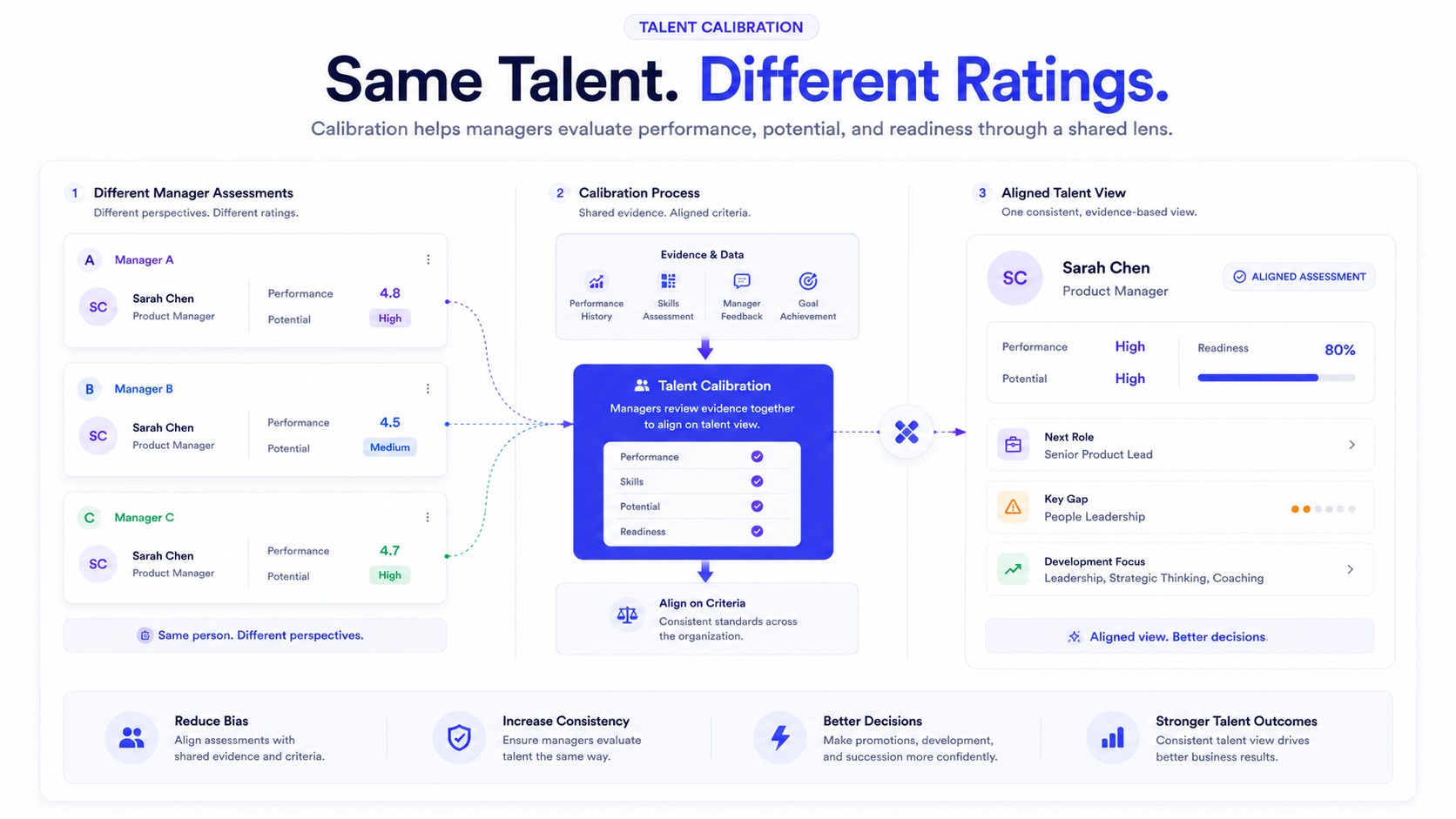
Talent Calibration is the process of reviewing and aligning talent assessments across managers to create a more consistent view of performance, potential, and readiness.
- Talent Calibration helps reduce differences in how managers assess employees.
- Calibration is not the same as forced ranking or assigning employees to fixed rating quotas.
- Effective calibration requires clear criteria, evidence, and consistent assessment standards.
- Talent Calibration supports talent review, succession planning, and internal mobility.
What Is Talent Calibration?
Two managers can look at the same employee and reach very different conclusions.
One manager might say:
“This person is a high performer. I think they’re ready for a bigger role.”
Another might say:
“Performance is strong, but I don’t see enough evidence that they’re ready for the next level.”
Who is right?
This is the problem Talent Calibration helps organizations address.
Talent Calibration is the process of reviewing, discussing, and aligning talent assessments across HR and managers to create a more consistent view of performance, potential, and readiness.
Put simply:
Talent Review tells you what you think about your talent. Talent Calibration helps make sure you’re looking at talent through a consistent lens.
Why Do Companies Need Talent Calibration?
One of the biggest challenges in talent management isn’t necessarily a lack of data.
It is this:
The same data can be interpreted differently by different managers.
For example:
Manager A tends to give high ratings.
Manager B is much more conservative.
The result:
Team A
Performance: 4.7 / 5

Team B
Performance: 3.9 / 5
That does not necessarily mean Team A has better talent.
The managers may simply be using different standards.
Talent Calibration brings those differences into the discussion.
How Does Talent Calibration Work?
A typical calibration process has four stages.
1. Collect
Gather relevant talent data, such as:
- Performance
- Skills
- Potential
- Career interests
- Readiness
- Manager assessments
- Relevant experience
2. Review
HR and managers review the data before the calibration session.
The goal is to avoid entering the discussion with opinions unsupported by evidence.
3. Discuss
Managers discuss cases where assessment differences or questions need to be explored.
For example:
“Why do we consider this employee high potential?”
“What evidence shows that they are ready for the next role?”
“Is this rating consistent with how we assess people in other teams?“
4. Align
After the discussion, the organization develops a more consistent view of:
- Performance
- Potential
- Readiness
- Development needs
- Succession candidates
Talent Calibration Is Not Forced Ranking
This is a common misunderstanding.
Calibration does not mean:
“Every team needs exactly 10% top performers.”
The goal of calibration is consistency, not quotas.
If one team genuinely has more high performers, the data should reflect that.
The real question is:
Are managers using the same standards when assessing talent?
For example:
Manager A defines “high potential” as:
Someone with strong performance.
Manager B defines it as:
Someone with leadership capability and the ability to handle greater scope.
They’re assessing two different things.
Calibration helps the organization clarify:
What does “high potential” actually mean in our organization?
Performance Is Not Potential
This is one of the most important reasons Talent Calibration matters.
An employee can perform extremely well in their current role without necessarily having the potential or readiness for the next one.
Think about it this way:
Performance
     ↓
How well are you doing today?

Potential
     ↓
How much can you grow?

Readiness
     ↓
How close are you to the next role?
These concepts are related, but they are not interchangeable.
For example, a Senior Sales Manager may consistently exceed their targets.
That demonstrates:
Strong current performance.
But if the next role requires:
- Strategic planning
- People leadership
- Cross-functional influence
- Financial management
the organization needs more evidence before concluding that the person is ready.
That is why calibration should not rely on performance ratings alone.
Talent Calibration and the 9-Box Grid
One of the most common frameworks used in talent calibration is the 9-Box Grid.
It typically places two dimensions against each other:
Performance
and
Potential
For example:
                 POTENTIAL

              Low    Medium    High

High          │       │         │
PERFORMANCE   │       │         │

Medium        │       │         │

Low           │       │         │
The important part isn’t simply placing someone into a box.
It is:
Why are they in that box?
A 9-Box Grid only becomes useful when there is evidence and discussion behind the placement.
Otherwise, it is simply a visually appealing matrix containing manager opinions.
How Does Calibration Help Reduce Bias?
No calibration process can completely eliminate bias.
But it can make bias more visible.
Visibility bias
A manager may rate someone highly because they frequently interact with leadership.
Meanwhile, another employee may contribute significantly but have less visibility.
Recency bias
A manager remembers a recent project very clearly and overlooks achievements from earlier in the year.
Similarity bias
A manager may unconsciously favor employees who work or communicate in ways similar to themselves.
Halo effect
One particularly strong characteristic influences the manager’s perception of the employee’s overall capability.
Calibration creates a forum where these assumptions can be challenged.
What Data Does Talent Calibration Need?
An effective calibration process does not require hundreds of metrics.
It needs the right evidence.
Performance
- Goals
- Outcomes
- Performance ratings
- Relevant achievements
Capability
- Skills
- Proficiency
- Role expectations
- Critical competencies
Potential
- Learning agility
- Leadership capability
- Scope potential
- Growth indicators
Readiness
- Current capability
- Required capability
- Skill gaps
- Experience gaps
Career context
- Career interests
- Mobility preferences
- Development goals
When these data points are connected, managers can evaluate talent from multiple perspectives instead of relying primarily on performance ratings.
Talent Calibration vs. Talent Review
The two concepts are closely related.
| Talent Review | Talent Calibration | |
|---|---|---|
| Primary goal | Understand talent and make decisions | Create consistency in assessments |
| Focus | Individual, team, or organization | Differences between assessments |
| Core question | ”Who are our critical talents?" | "Are we assessing them consistently?” |
| Output | Talent decisions | Aligned talent view |
| Participants | HR + Managers | HR + Managers |
A simple way to think about it:
Talent Review = What do we see?
Talent Calibration = Are we seeing it consistently?
The two processes should work together.
Talent Calibration and Succession Planning
Calibration also plays an important role in succession planning.
Instead of simply asking:
“Who is the successor for this role?”
Organizations can ask:
Does this person have the required skills?
Where are the gaps?
How ready are they today?
What development is needed before they take the role?
For example:
Critical Role
      ↓
Required Skills
      ↓
Internal Talent Pool
      ↓
Potential Successors
      ↓
Readiness
      ↓
Development Plan
This turns succession planning from a list of names into a capability-based process.
How to Build an Effective Talent Calibration Process
Step 1: Define clear criteria
Align on:
- What is performance?
- What is potential?
- What is readiness?
- What does high potential mean?
Step 2: Use evidence
Don’t start with:
“I think this person is great.”
Start with:
“What evidence supports that assessment?”
Step 3: Calibrate across teams
Don’t limit calibration to individual teams.
Where possible, managers should review talent across the organization.
Step 4: Separate performance from potential
Someone can be:
- High performance / Low potential
- High performance / High potential
- Low performance / High potential
Each situation requires a different action.
Step 5: Connect assessment to action
Calibration should lead to:
- Development
- Internal mobility
- Succession
- Retention
- Stretch assignments
If calibration ends with a matrix and no action, it can quickly become another annual HR ritual.
How Is Talent Calibration Changing?
Traditional Talent Calibration often relies heavily on:
Manager opinion + Performance rating
A more data-driven approach adds:
Performance + Skills + Potential + Readiness + Workforce context
This helps organizations move from:
“Who looks like a top talent?”
to:
“What evidence tells us this person can create value in a larger or different role?”
That is the shift from talent assessment toward talent intelligence.
Talent Calibration and SkillMAP
SkillMAP adds a layer of skills and capability data to the talent assessment process.
Instead of relying only on performance ratings or manager assessments, HR can also consider:
- Current skills
- Skill proficiency
- Skill gaps
- Role requirements
- Career readiness
- Internal mobility potential
This gives Talent Calibration stronger evidence for answering:
Who is performing well?
Who has potential?
Who is ready for the next role?
Who needs development before moving?
👉 Explore SkillMAP Demo with sample data
FAQs
What is Talent Calibration?
Talent Calibration is the process of reviewing and aligning talent assessments across HR and managers to create a more consistent view of performance, potential, and readiness.
Is Talent Calibration the same as Performance Review?
No. Performance Review typically focuses on evaluating an individual employee, while Talent Calibration focuses on creating consistency across managers and teams.
Is Talent Calibration the same as Forced Ranking?
No. Calibration aims to improve assessment consistency and quality. It does not necessarily require employees to be distributed according to fixed rating quotas.
Is Talent Calibration related to the 9-Box Grid?
Yes. The 9-Box Grid is commonly used as a framework for calibration, particularly when organizations want to assess performance and potential together.
What data is needed for Talent Calibration?
An effective process can combine performance, skills, potential, readiness, role requirements, career interests, and evidence from multiple sources.
Frequently Asked Questions
What is Talent Calibration?
Talent Calibration is a process where HR and managers review and discuss talent assessments to create a more consistent view of performance, potential, and readiness.
Is Talent Calibration the same as Performance Review?
No. Performance Review typically evaluates an individual employee, while Talent Calibration focuses on creating consistency across managers and teams.
Is Talent Calibration the same as forced ranking?
No. Calibration aims to improve consistency and assessment quality. It does not necessarily require employees to be distributed according to fixed rating quotas.
What data is needed for Talent Calibration?
Effective calibration can combine performance, skills, potential indicators, readiness, role requirements, career interests, and evidence from multiple sources.