Quick Takeaways
An HRIS manages employee records and HR operations. A Talent Intelligence Platform analyzes workforce capabilities to support hiring, development, internal mobility, succession planning, and strategic talent decisions.
- HRIS manages employee information and HR operations.
- Talent Intelligence provides visibility into workforce capabilities.
- The two systems complement each other rather than compete.
- Growing organizations often benefit from using both.
HRIS vs Talent Intelligence Platform: What’s the Difference?
As organizations invest in HR technology, two categories often appear during the evaluation process:
- HRIS
- Talent Intelligence Platform
At first glance, they seem similar.
Both store employee data.
Both are used by HR teams.
Both aim to improve workforce management.
However, they solve very different business problems.
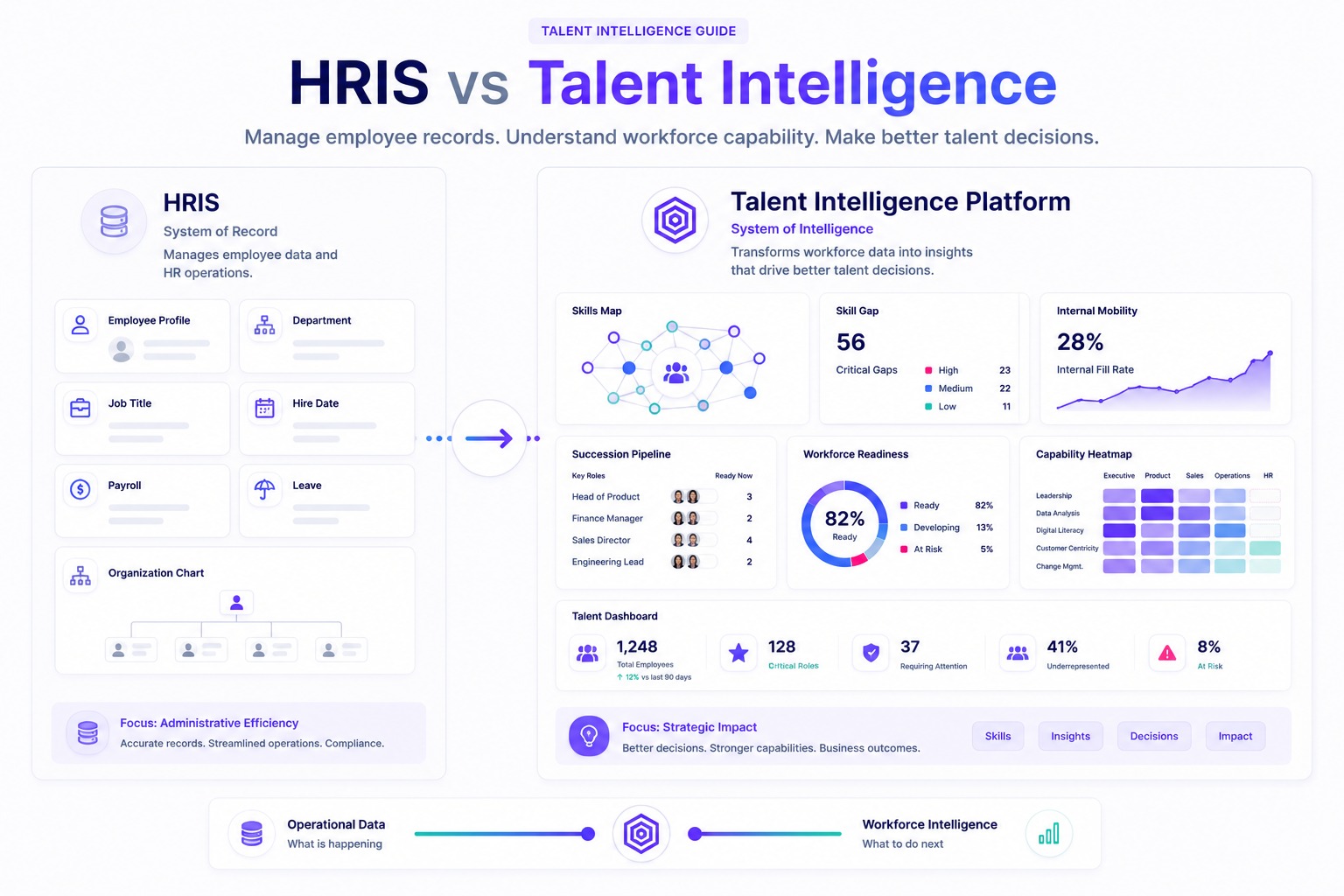
An HRIS helps organizations manage employee information and HR operations.
A Talent Intelligence Platform helps leaders understand workforce capabilities and make better talent decisions.
Rather than replacing one another, they serve different purposes and often work best together.
What Is an HRIS?
A Human Resource Information System (HRIS) is the central system for managing employee records and day-to-day HR operations.
Typical HRIS functions include:
- Employee profiles
- Organizational structure
- Employment contracts
- Payroll
- Leave management
- Attendance
- Benefits administration
- Compliance records
In short, an HRIS answers questions like:
- Who works here?
- Which department are they in?
- What is their employment status?
- What administrative information do we have about them?
It provides the operational foundation for HR.
What Is a Talent Intelligence Platform?
A Talent Intelligence Platform focuses on a different type of data.
Instead of administrative records, it analyzes workforce capabilities.
For example:
- What skills does each employee possess?
- Which employees are ready for promotion?
- Where are the largest skill gaps?
- Which teams face capability risks?
- Who could move into another role through Internal Mobility?
- Which skills should be developed instead of hired?
Rather than managing people records, Talent Intelligence helps organizations understand what their people are capable of.
HRIS vs Talent Intelligence Platform
| Category | HRIS | Talent Intelligence Platform |
|---|---|---|
| Primary purpose | HR operations | Talent decision-making |
| Core data | Employee records | Skills, competencies, capabilities |
| Focus | Administration | Workforce intelligence |
| Primary users | HR Operations | HR Leaders, HRBPs, CEOs |
| Answers | ”Who are our employees?" | "What are our employees capable of?” |
| Business value | Operational efficiency | Better strategic decisions |
Although they both use employee data, the questions they answer are fundamentally different.
Why an HRIS Alone Isn’t Enough
An HRIS can tell you:
- You have 180 employees.
- Twelve employees joined this quarter.
- Twenty-four people are managers.
- Payroll has been completed successfully.
But it usually cannot answer questions such as:
- How many employees have advanced data analysis skills?
- Which engineers are ready to become team leads?
- Which department has the biggest capability gap?
- Which critical roles lack succession candidates?
- Should we hire externally or develop internal talent?
These questions require visibility into workforce capability rather than employee records.
That is where Talent Intelligence becomes valuable.
Talent Intelligence Doesn’t Replace an HRIS
One common misconception is that Talent Intelligence is simply a more advanced HRIS.
It isn’t.
The two platforms serve different purposes.
A simple way to think about it is:
- HRIS stores workforce data.
- Talent Intelligence transforms workforce data into actionable insights.
Or put another way:
HRIS records what exists today. Talent Intelligence helps organizations decide what to do next.
This distinction becomes increasingly important as organizations grow and workforce decisions become more complex.
When Does a Company Need Talent Intelligence?
Many organizations begin with an HRIS.
As the company grows, new questions emerge:
- Do we have the capabilities to execute next year’s strategy?
- Which teams need upskilling?
- Who is ready for leadership?
- Where should we invest in learning and development?
- Which critical skills are missing across the organization?
- Can we promote internally instead of hiring externally?
When these questions become part of regular business planning, operational HR data is no longer enough.
Organizations need workforce intelligence.
How HRIS and Talent Intelligence Work Together
Rather than competing, the two systems complement each other.
The HRIS provides trusted employee information.
The Talent Intelligence Platform enriches that information with capability data and strategic insights — including:
Together, they create a more complete picture of the workforce.
Which One Should Growing Companies Choose?
The answer depends on the business problem.
If your primary challenge is managing employee records, payroll, leave, and compliance, an HRIS is essential.
If your challenge is understanding workforce capability, preparing future leaders, identifying skill gaps, or making smarter talent decisions, Talent Intelligence becomes increasingly valuable.
For many growing organizations, the best approach is not choosing one over the other.
It is using both systems together.
An HRIS keeps operations running efficiently.
A Talent Intelligence Platform helps ensure the workforce is ready for future growth.
Conclusion
HRIS and Talent Intelligence Platforms are often discussed together, but they solve different problems.
An HRIS manages people.
A Talent Intelligence Platform helps organizations understand what their people can do.
As businesses grow, success depends not only on maintaining accurate employee records but also on making informed talent decisions.
The question is no longer:
“How many employees do we have?”
It becomes:
“Do we have the capabilities needed to achieve our next business goal?”
That is the question Talent Intelligence is designed to answer.
Related Articles
- What Is Talent Intelligence?
- Talent Intelligence Platform
- What Is Workforce Analytics?
- What Is Workforce Planning?
- What Is Internal Mobility?
- Competency Management Software
Frequently Asked Questions
What is an HRIS?
An HRIS (Human Resource Information System) is a platform for managing employee records, payroll, attendance, contracts, and day-to-day HR operations.
What is a Talent Intelligence Platform?
A Talent Intelligence Platform analyzes workforce capabilities — including skills, competencies, and readiness — to support strategic talent decisions.
Can an HRIS replace a Talent Intelligence Platform?
No. HRIS platforms focus on operational HR processes, while Talent Intelligence provides insights into skills, readiness, and workforce planning.
When should a company invest in Talent Intelligence?
When workforce planning, leadership development, internal mobility, and skills visibility become strategic priorities for the business.