Quick Takeaways
Workforce Analytics is the process of collecting, analyzing, and visualizing workforce data to support better business and talent decisions.
- Workforce Analytics goes beyond reporting to uncover insights and predict future workforce needs.
- It helps organizations improve workforce planning, talent development, and leadership decisions.
- Workforce Analytics provides the data foundation for Talent Intelligence.
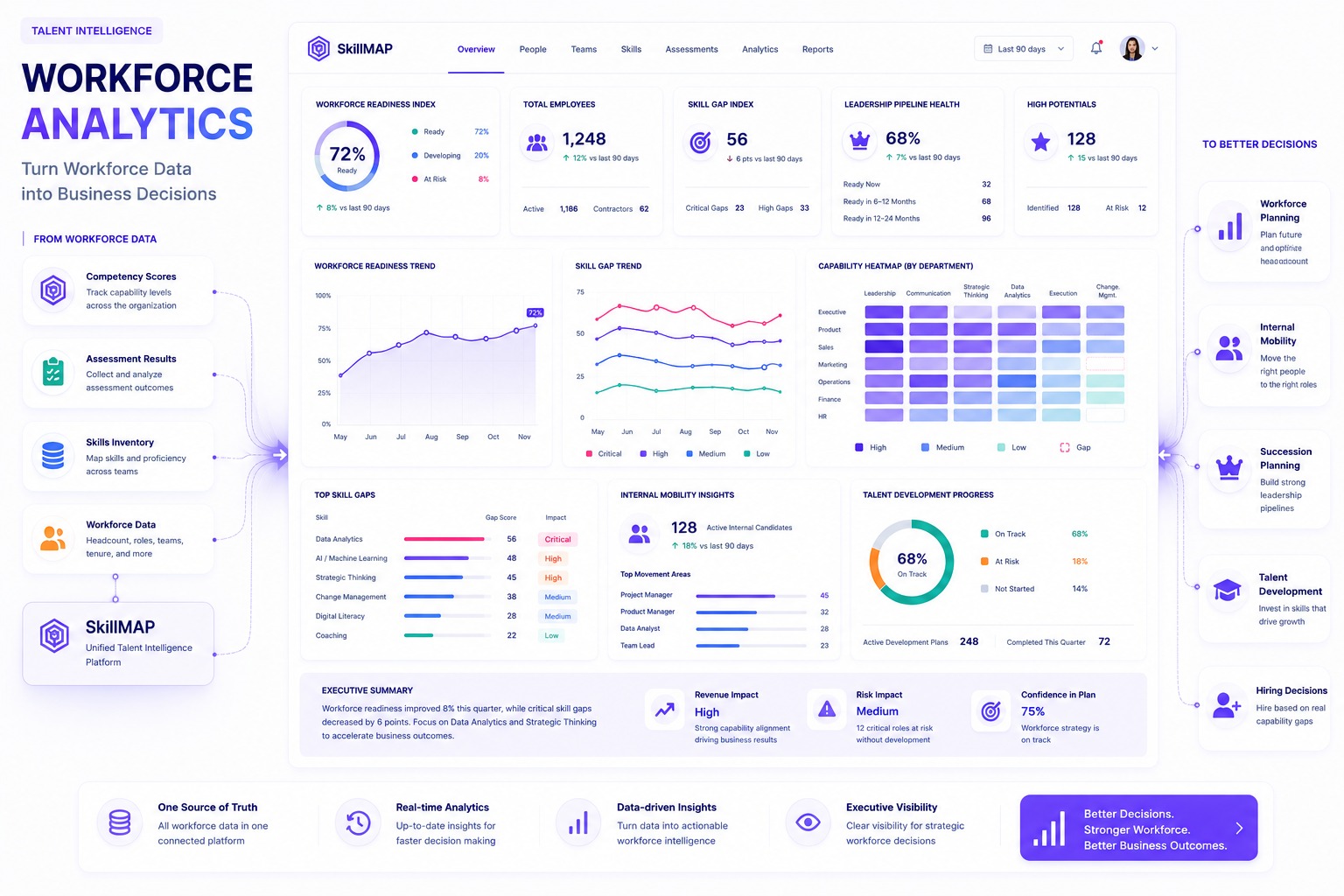
What Is Workforce Analytics?
Most organizations already have plenty of HR data.
They know:
- How many employees they have.
- Their turnover rate.
- Recruitment costs.
- Performance review results.
- Learning and development budgets.
However, when executives ask questions like:
Is our current workforce capable of supporting next year’s growth strategy?
Or:
Should we hire more people or invest in developing our existing workforce?
Many organizations struggle to provide clear answers.
The problem isn’t the lack of data.
The problem is turning data into insight.
This is exactly what Workforce Analytics is designed to do.
What Is Workforce Analytics?
Workforce Analytics is the process of collecting, analyzing, and visualizing workforce data to understand what is happening, why it is happening, and what is likely to happen next.
Rather than simply presenting HR metrics, Workforce Analytics connects workforce capability data with business outcomes, helping leaders make more informed decisions.
Workforce Analytics vs HR Reporting
These two concepts are often confused.
| HR Reporting | Workforce Analytics |
|---|---|
| Describes data | Analyzes data |
| Answers “What happened?” | Answers “Why did it happen?” and “What will happen next?” |
| Dashboards and reports | Insights and predictions |
| Supports HR operations | Supports strategic business decisions |
For example:
HR Reporting might tell you:
Employee turnover reached 18% last quarter.
Workforce Analytics goes further by answering:
- Which teams are driving turnover?
- Which critical capabilities are being lost?
- How will this impact future business performance?
- Should we recruit externally or invest in internal development?
Workforce Analytics vs People Analytics
The two terms are closely related but focus on different perspectives.
People Analytics typically focuses on individuals.
Questions include:
- How is an employee performing?
- Which learning programs improve performance?
- What factors influence engagement?
Workforce Analytics focuses on the workforce as a whole.
Questions include:
- Does the organization have the capabilities required for future growth?
- Which departments face the highest workforce risk?
- Where should capability investments be prioritized?
Both disciplines complement each other and contribute to a broader Talent Intelligence strategy.
Key Workforce Analytics Metrics
A modern Workforce Analytics platform should track multiple categories of workforce data.
Workforce Capability
Organizations need visibility into:
- Competency scores
- Skill distribution
- Critical capability coverage
This information often comes from structured Competency Assessments.
Skill Gaps
Through Skill Gap Analysis, organizations can identify:
- Missing capabilities
- Critical business risks
- Development priorities
Instead of relying on intuition, leaders gain objective workforce insights.
Workforce Readiness
Strong performance today doesn’t necessarily mean the workforce is prepared for tomorrow.
Tracking Workforce Readiness helps organizations understand whether their current capabilities align with future business goals.
Internal Mobility
Analytics can also answer questions such as:
- How many leadership roles were filled internally?
- Which departments have the strongest succession pipeline?
- Which teams produce future leaders most consistently?
These insights directly support Internal Mobility initiatives.
Workforce Analytics and Workforce Planning
One of the most valuable applications of Workforce Analytics is improving Workforce Planning.
Imagine a company planning to open two new regional offices next year.
Analytics reveals:
- Three additional Sales Managers will be required.
- Only one Team Lead is currently ready for promotion.
- Coaching capability is consistently below target across multiple teams.
Armed with this information, leaders can decide whether to:
- Invest in leadership development.
- Recruit externally.
- Accelerate internal mobility.
- Adjust hiring timelines.
Instead of reacting to workforce shortages, organizations can prepare in advance.
Common Workforce Analytics Mistakes
Focusing Only on HR Metrics
Metrics such as turnover and time-to-hire are important.
But they don’t explain whether the workforce has the capabilities needed to execute business strategy.
Collecting Data Without Analysis
Many dashboards display numbers.
Very few generate meaningful insights.
Without analysis, data cannot improve decision-making.
Fragmented Workforce Data
Competencies.
Assessments.
Training.
Succession planning.
Each dataset often lives in a separate system.
Without connecting these data sources, Workforce Analytics remains incomplete.
Workforce Analytics Is the Foundation of Talent Intelligence
Workforce Analytics is not the final destination.
It is the analytical foundation that enables Talent Intelligence.
When organizations combine data from:
- Competency Frameworks
- Skills Inventories
- Skill Gap Analysis
- Career Paths
- Succession Planning
- Workforce Readiness
they can answer strategic questions such as:
- Do we have the capabilities needed for future growth?
- Who is ready for critical leadership roles?
- Where are our biggest workforce risks?
- Should we develop talent internally or recruit externally?
At this point, workforce data becomes much more than an HR report.
It becomes a strategic business asset.
Explore How SkillMAP Powers Workforce Analytics
SkillMAP helps organizations:
- Centralize competency data
- Visualize workforce capabilities
- Identify skill gaps
- Track Workforce Readiness
- Support Workforce Planning
- Build Talent Intelligence using workforce data
👉 Explore SkillMAP Demo with sample data
👉 Or talk with our team about Workforce Analytics for your organization
Frequently Asked Questions
What is Workforce Analytics?
Workforce Analytics is the practice of analyzing workforce data to improve business decisions related to talent, capability, and organizational planning.
How is Workforce Analytics different from HR Reporting?
HR Reporting describes what happened, while Workforce Analytics explains why it happened and helps predict what may happen next.