Quick Takeaways
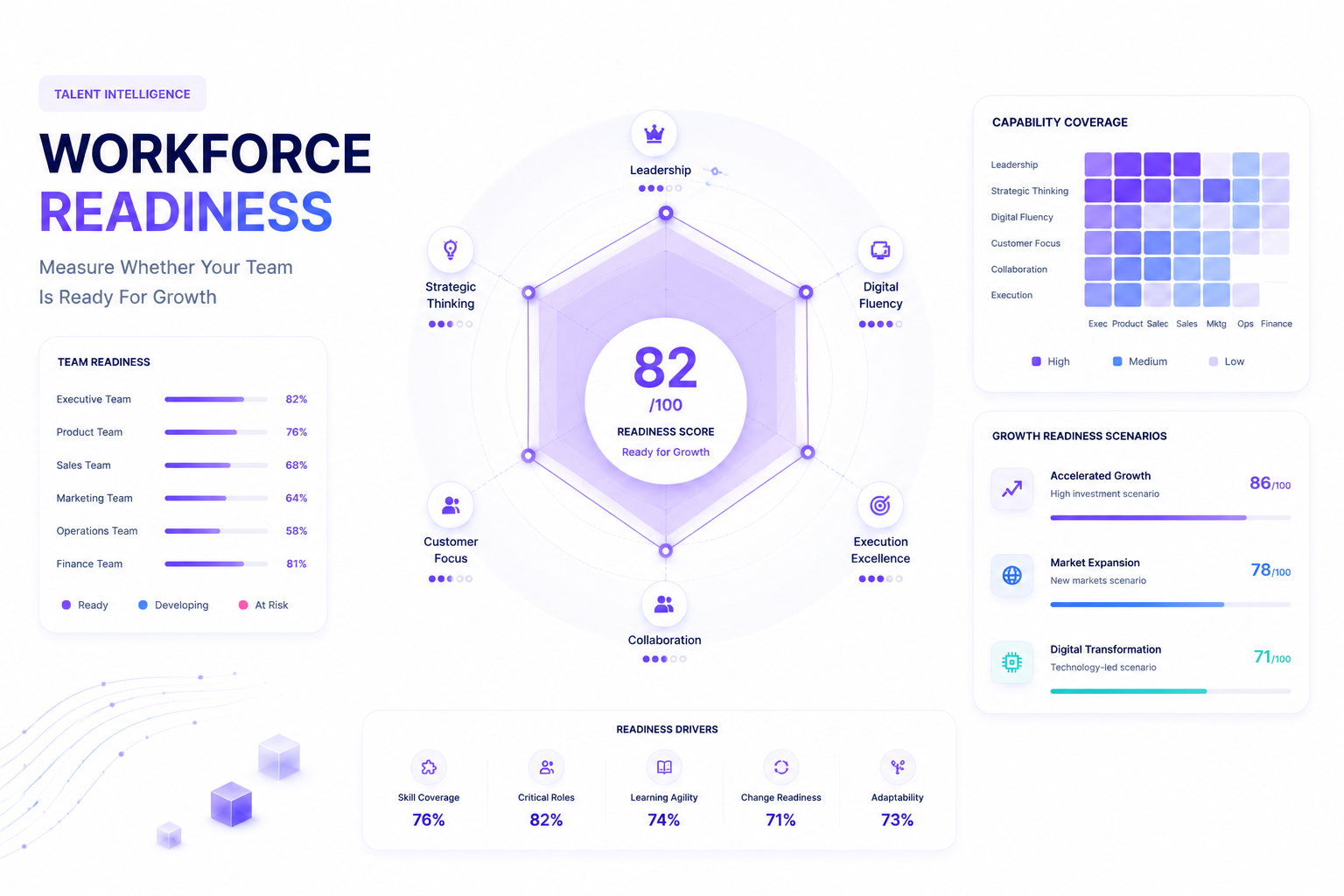
Workforce Readiness measures whether employees and teams have the capabilities required to execute future business objectives and growth plans.
- Workforce Readiness focuses on future capability, not just current performance.
- Competency data becomes valuable when connected to business strategy.
- Talent Intelligence helps organizations identify readiness gaps before they impact growth.
What Is Workforce Readiness?
Many organizations know how their employees performed last quarter.
Far fewer can answer a more strategic question:
Is our workforce capable of delivering the company’s growth plans over the next 12 to 24 months?
This is the question that Workforce Readiness is designed to answer.
Workforce Readiness measures whether employees, teams, and the broader organization have the competencies required to execute future business objectives.
Rather than focusing solely on performance today, Workforce Readiness focuses on preparedness for tomorrow.
Why Workforce Readiness Matters
As organizations grow, business requirements evolve.
The capabilities that supported a 30-person company may not be enough for a 200-person organization.
Common challenges include:
- Lack of leadership capacity
- Critical skill shortages
- Difficulty executing strategic initiatives
- Dependence on a few key employees
- Increasing hiring costs
Many companies assume these are staffing problems.
In reality, they are often readiness problems.
The issue is not how many people the organization has.
The issue is whether the organization has the right capabilities.
Workforce Readiness vs Performance Management
This distinction is important.
| Performance Management | Workforce Readiness |
|---|---|
| Focuses on past results | Focuses on future capability |
| Evaluates individual outcomes | Evaluates organizational preparedness |
| Measures performance | Measures readiness |
| Often supports compensation decisions | Supports workforce strategy |
For example:
A team may achieve all current targets.
However, if nobody is prepared to lead the next phase of growth, workforce readiness remains low.
How Workforce Readiness Is Measured
Workforce Readiness typically combines multiple data sources.
Competency Framework
Organizations first need a clear understanding of the competencies required for success.
This usually starts with a Competency Framework that defines:
- Skills
- Behaviors
- Knowledge
- Proficiency levels
Without a framework, readiness becomes difficult to measure consistently.
Competency Assessment
The next step is understanding current workforce capabilities.
Many organizations use Employee Competency Assessment Software to collect and standardize competency data.
This creates visibility into the workforce at scale.
Skill Gap Analysis
Once expectations and current capabilities are defined, organizations can identify gaps.
Skill Gap Analysis helps answer questions such as:
- Which competencies are missing?
- Where are the largest capability gaps?
- Which teams require development investment?
Readiness Scoring
Organizations often calculate readiness based on:
- Competency coverage
- Leadership bench strength
- Succession readiness
- Critical role preparedness
The result is a clearer view of organizational capability.
Common Signs Of Low Workforce Readiness
Organizations often experience low readiness before they recognize it.
Common indicators include:
- Difficulty promoting internally
- Leadership vacancies with no successors
- Delays in strategic projects
- Repeated hiring for the same capabilities
- Heavy reliance on a few experts
These signals often point to workforce capability gaps rather than staffing shortages.
Workforce Readiness And Talent Intelligence
Workforce Readiness is one of the most valuable outcomes of Talent Intelligence.
Instead of asking:
How did employees perform?
Organizations begin asking:
Is our workforce prepared for what comes next?
This shift transforms workforce data into strategic business intelligence.
Leaders gain visibility into:
- Readiness for growth
- Succession risk
- Leadership pipeline health
- Organizational capability gaps
- Future workforce investments
Common Mistakes When Measuring Workforce Readiness
Looking Only At Performance Data
Strong performance does not automatically indicate future readiness.
Measuring Individuals Instead Of Teams
Readiness should be evaluated across the organization, not only at the employee level.
Ignoring Future Business Strategy
Capability requirements should be aligned with future business goals rather than current responsibilities.
From Workforce Readiness To Strategic Workforce Planning
Organizations that understand workforce readiness can make better decisions about:
- Hiring
- Leadership development
- Internal mobility
- Succession planning
- Workforce investment
This creates a more resilient organization capable of supporting long-term growth.
See How SkillMAP Measures Workforce Readiness
SkillMAP helps organizations:
- Build competency frameworks
- Assess workforce capabilities
- Identify skill gaps
- Measure workforce readiness
- Support succession planning
- Enable Talent Intelligence through workforce data
👉 Explore SkillMAP Demo with sample data
👉 Or talk with our team about Workforce Readiness strategy for your organization
Frequently Asked Questions
What is Workforce Readiness?
Workforce Readiness measures whether employees and teams possess the skills and competencies required to support future business objectives.
How is Workforce Readiness different from performance management?
Performance management evaluates past or current results, while Workforce Readiness evaluates future capability and preparedness.