Quick Takeaways
A Competency Framework is a structured system that standardizes the knowledge, skills, and behaviors required for each role, helping SMEs move beyond measuring outcomes (KPIs) toward sustainable workforce development.
- KPIs measure outcomes, while a competency framework defines the capabilities required to achieve those outcomes.
- SMEs benefit significantly from competency frameworks by reducing subjective hiring decisions and inconsistent performance evaluations.
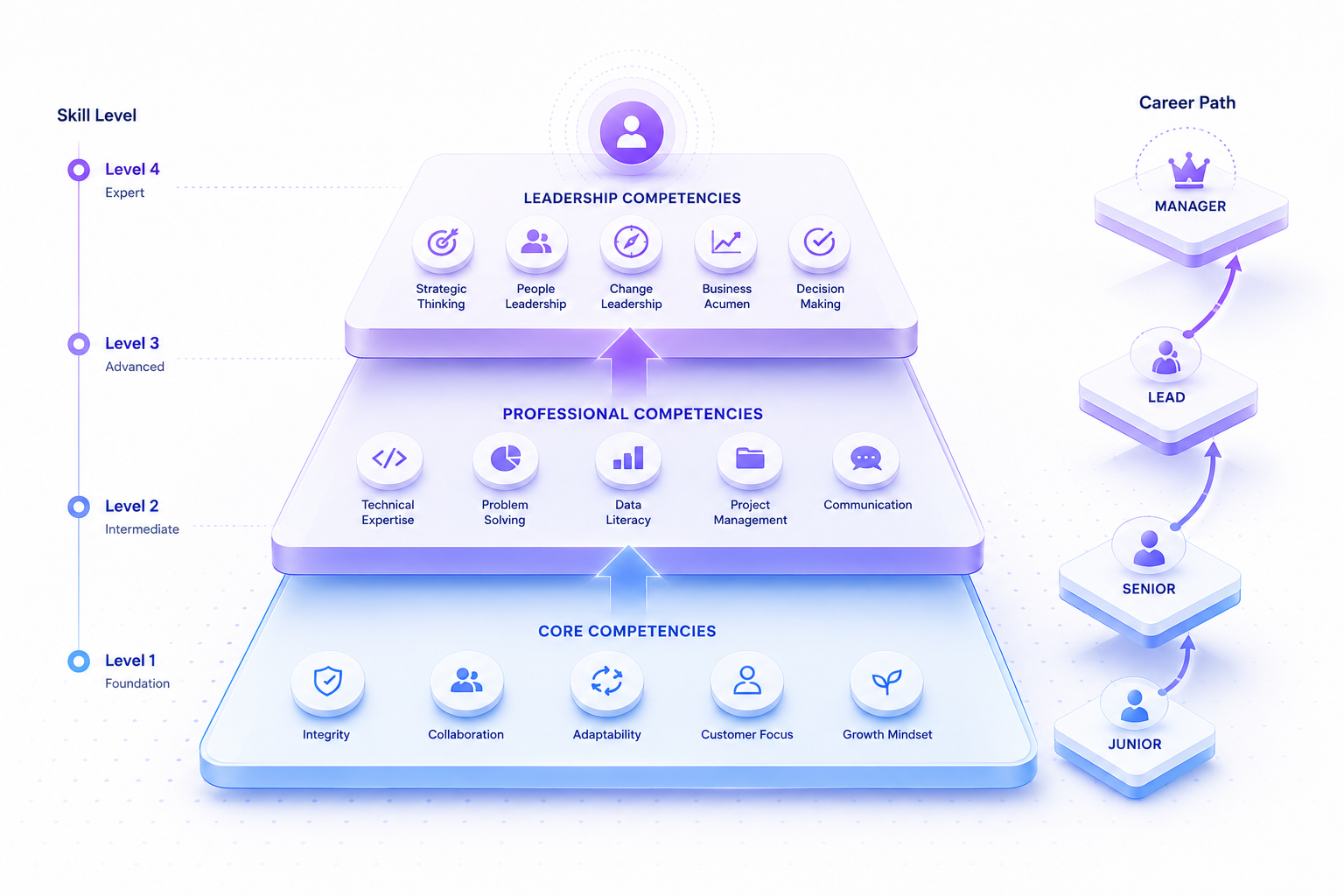
- A standard competency framework consists of three layers: Core Competencies, Professional Competencies, and Leadership Competencies.
- SMEs should start with critical business roles rather than attempting to build a complex framework for the entire organization at once.
As organizations grow from a few dozen employees to several hundred, certain questions begin to surface more frequently:
“Why do some top performers struggle when promoted into management roles?”
Or:
“Why do two employees with identical KPIs contribute very differently to the organization?”
The common thread behind these questions is that businesses often measure outcomes without fully understanding the capabilities that drive those outcomes.
That is why many organizations adopt a Competency Framework as the foundation for hiring, performance evaluation, learning and development, and workforce growth.
What Is a Competency Framework?

Illustration: Core Competencies → Professional Competencies → Leadership Competencies forming a complete framework.
A Competency Framework is a structured system that defines the knowledge, skills, behaviors, and capabilities required for an individual to perform successfully in a specific role.
Put simply: if KPIs answer the question “What results should be achieved?”, a competency framework answers “What capabilities are required to achieve those results?”
A typical competency framework includes:
- Knowledge
- Skills
- Behaviors
- Mindset and Attitudes
Why Do SMEs Need a Competency Framework?

Illustration: KPIs measure outcomes while competencies measure capabilities.
Many small and mid-sized businesses assume competency frameworks are only relevant for large enterprises. In reality, SMEs often benefit the most.
Without a competency framework, organizations commonly face challenges such as: hiring based on intuition rather than objective criteria, inconsistent employee evaluations, difficulty building career progression paths, limited visibility into actual training needs, and heavy dependence on a small number of key individuals.
A competency framework creates a shared language across the organization, helping teams define what good performance actually looks like and standardizing talent management decisions.
The Structure of a Competency Framework
1. Core Competencies
These are the capabilities every employee should possess regardless of role or department.
Examples: continuous learning, collaboration, customer-centric thinking, proactive problem solving.
2. Professional Competencies
These competencies are directly related to specific functions or departments.
- For Sales Teams: negotiation, pipeline management, customer needs analysis.
- For Product Teams: product discovery, data analysis, user research.
3. Leadership Competencies
These competencies are designed for managers and organizational leaders.
Examples: coaching, decision-making, performance management, team development.
How Is a Competency Framework Different From KPIs?
This is one of the most common misconceptions in talent management.
| Criteria | KPI | Competency Framework |
|---|---|---|
| Purpose | Measures outcomes | Measures the ability to create outcomes |
| Focus | Short-term objectives | Long-term capabilities |
| Frequency | Typically reviewed periodically (monthly, quarterly, annually) | Can evolve continuously |
| Application | Supports compensation and accountability | Supports employee development |
Example: A Sales Executive achieves 120% of quota. The KPI tells you the employee exceeded expectations. A competency framework helps answer deeper questions: which competencies drove that success? Can those competencies be replicated across the team? Is this employee truly ready for a leadership role?
How to Build a Competency Framework for SMEs

Illustration: Identify Roles → Define Competencies → Set Proficiency Levels → Assess Employees → Create Development Plans.
Step 1: Identify Critical Roles
Do not attempt to cover the entire organization from day one. Start with high-impact functions such as Sales, Marketing, Product, Customer Success, or Team Leads.
Step 2: Define Required Competencies
Ask: “What does an exceptional performer in this role consistently do well?” Focus on observable and measurable behaviors rather than vague descriptions.
Step 3: Create Proficiency Levels
Break each competency into progressive levels — for example, Level 1 (Basic), Level 2 (Proficient), Level 3 (Advanced), Level 4 (Expert).
Step 4: Connect It to Competency Assessments
A competency framework only creates value when it becomes part of day-to-day operations. This is the foundation of modern employee competency assessment systems.
Competency Frameworks and Skill Gap Analysis
Once required competencies are defined for a role, organizations can compare them against current employee capabilities. The difference between the required state and the current state is known as a Skill Gap.
Example: A Team Lead role requires Coaching at Level 3 and Strategic Thinking at Level 3. A current employee may demonstrate Coaching at Level 2 and Strategic Thinking at Level 1. This gap provides a clear and objective foundation for development planning.
Competency Frameworks and Career Paths
One of the greatest benefits of a competency framework is the ability to create transparent career progression paths.
Instead of saying “Perform well and you may get promoted,” organizations can clearly communicate: “To become a Team Lead, you need to achieve Level 3 proficiency in Competencies A, B, and C.” This transparency improves employee motivation, engagement, and retention.
Common Mistakes When Building a Competency Framework
- Making It Too Complex: Many organizations attempt to define hundreds of competencies from the beginning, creating an overly complicated system that becomes difficult to maintain.
- Failing to Update It: Competencies should evolve alongside business strategy and organizational growth.
- Disconnecting It From Daily Operations: A competency framework should never become a document that sits unused in an HR folder. Its value comes from being embedded into hiring, development, promotion, and workforce planning decisions.
From Competency Frameworks to Talent Intelligence
A competency framework is the foundation. The strategic value emerges when organizations use competency data to answer questions such as: where is our workforce strongest? Which capabilities are missing? Who is ready for the next role? Which positions carry succession risk?
This is the point where raw workforce data becomes Talent Intelligence. Instead of merely documenting competencies, organizations gain the visibility needed to make better talent decisions and support sustainable growth.
See How SkillMAP Visualizes Competency Frameworks
SkillMAP is a Talent Intelligence platform that helps SMEs digitize and optimize competency management processes.
With SkillMAP, organizations can build and standardize competency frameworks, conduct multi-dimensional competency assessments, visualize and identify skill gaps, track readiness for future roles, and support data-driven talent development.
Frequently Asked Questions
How is a competency framework different from KPIs?
KPIs measure work outcomes and performance results, while a competency framework measures the capabilities that enable those outcomes and supports long-term employee development.
Where should SMEs start when building a competency framework?
Start with business-critical roles such as Sales, Product, or Team Leads before expanding to the rest of the organization.
Why is a competency framework important for career pathing?
Because it creates transparency around promotion requirements. Employees understand exactly which competencies and proficiency levels they need to achieve in order to move into the next role.