Quick Takeaways
Competency Management Software helps organizations manage, assess, and utilize workforce competency data to support talent development and Talent Intelligence.
- Excel works in the early stages but becomes difficult to scale.
- Competency Management Software centralizes workforce capability data.
- Competency data powers Skill Gap Analysis, Career Paths, and Talent Intelligence.
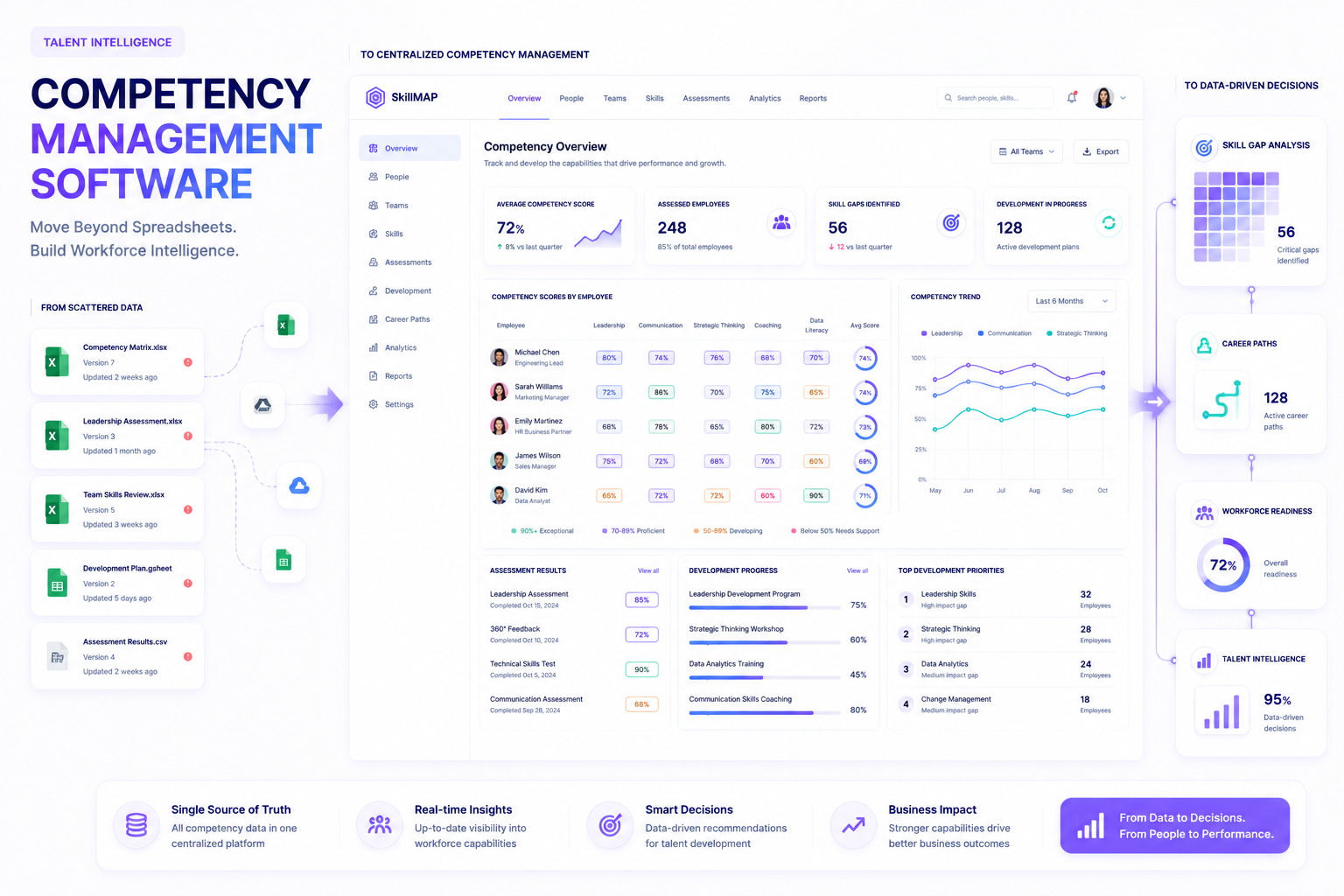
What Is Competency Management Software?
Many organizations begin managing competencies using spreadsheets.
This approach makes sense.
In the early stages, workforce size is small and competency management requirements are relatively simple.
However, as organizations grow to 50, 100, or 200 employees, spreadsheets often become a limitation rather than a solution.
HR teams manage multiple versions of the same file.
Managers maintain separate records.
Competency data becomes scattered across systems and documents.
Eventually, the organization loses visibility into workforce capabilities.
This is where Competency Management Software becomes essential.
Competency Management Software is a system that helps organizations build, manage, and utilize workforce competency data in a centralized and scalable way.
Why Excel Is No Longer Enough
Spreadsheets are excellent tools for getting started.
But they were never designed to serve as long-term competency management systems.
Common challenges include:
- Data scattered across multiple files
- Version control issues
- Limited reporting and visualization
- No historical competency tracking
- Poor scalability as organizations grow
As organizations mature, the challenge is no longer collecting data.
The challenge becomes turning data into decisions.
What Does Competency Management Software Do?
Modern competency management platforms provide far more than data storage.
Build Competency Frameworks
Organizations can define:
- Competencies
- Behavioral indicators
- Proficiency levels
- Role-specific requirements
This creates consistency across the organization.
If your organization is still developing its framework, start with our guide on What Is a Competency Framework?.
Conduct Competency Assessments
The platform can support:
- Self-assessments
- Manager assessments
- Multi-rater feedback
- Calibration processes
Data is centralized rather than distributed across spreadsheets and emails.
Track Development Over Time
Competencies are not static.
Organizations need visibility into:
- Capability growth
- Training outcomes
- Workforce readiness
- Progress toward future roles
A dedicated platform makes this possible.
Competency Assessment Is Only the Beginning
One of the most common mistakes organizations make is treating competency assessment as the final goal.
Assessment is only the first step.
The real value comes from what happens after the assessment.
Organizations need answers to questions such as:
- Which skills are missing?
- Who is ready for promotion?
- Does the workforce have the capabilities needed for future growth?
Competency Management Software helps transform assessment data into actionable insights.
Competency Management Software and Skill Gap Analysis
Once competency data exists, organizations can perform Skill Gap Analysis.
For example:
| Competency | Required Level | Current Level |
|---|---|---|
| Coaching | Level 3 | Level 2 |
| Strategic Thinking | Level 3 | Level 1 |
These gaps become the foundation for decisions related to:
- Learning and development
- Leadership development
- Workforce planning
- Recruitment
Competency Management Software and Career Paths
One of the most valuable uses of competency data is supporting Career Paths.
Instead of saying:
“Keep performing well and you’ll be promoted.”
Organizations can say:
“To become a Team Lead, you need to reach Level 3 in Competencies A, B, and C.”
This makes career growth more transparent and objective.
Signs It’s Time to Move Beyond Excel
Organizations should consider Competency Management Software when:
Competency Data Is Fragmented
Different teams maintain different files.
No one knows which version is current.
Assessments Are Becoming Difficult to Manage
HR spends weeks consolidating data from multiple sources.
Skill Gaps Are Invisible
Data exists, but meaningful insights do not.
Workforce Decisions Lack Data
Competency information is not supporting decisions related to:
- Promotions
- Internal Mobility
- Succession Planning
- Workforce Planning
From Competency Management to Talent Intelligence
Competency data creates value when it informs workforce decisions.
This is why many organizations are moving beyond competency management toward Talent Intelligence.
Talent Intelligence helps answer questions such as:
- Where are our workforce strengths?
- Which capabilities are missing?
- Who is ready for future roles?
- Should we build or buy talent?
At this stage, competency data becomes more than an HR asset.
It becomes a strategic business asset.
Explore How SkillMAP Supports Competency Management
SkillMAP helps organizations:
- Build competency frameworks
- Assess workforce capabilities
- Track development over time
- Identify skill gaps
- Support career paths
- Build Talent Intelligence using workforce data
👉 Explore SkillMAP Demo with sample data
👉 Or talk with our team about competency management strategy
Frequently Asked Questions
What is Competency Management Software?
Competency Management Software is a platform that helps organizations manage, assess, and track workforce competencies over time.
When should organizations replace Excel with Competency Management Software?
Organizations should consider specialized software when competency data becomes fragmented, difficult to maintain, or no longer supports workforce decision-making effectively.