Quick Takeaways
Competency Management is the continuous process of defining, assessing, developing, and monitoring workforce competencies to support business goals.
- Competency Management is an ongoing process, not a one-time assessment.
- It connects competency frameworks, assessments, and employee development.
- Organizations use Competency Management to improve workforce capability and talent decisions.
- Talent Intelligence platforms make Competency Management scalable.
What is Competency Management?
Many organizations already have a competency framework.
Some even conduct competency assessments every year.
Yet six months later, very little has changed.
Employees still lack critical skills.
Managers still struggle to identify development priorities.
Leadership still lacks visibility into workforce capability.
The problem isn’t the framework.
The problem isn’t the assessment.
The problem is the absence of Competency Management.
Competency Management ensures competency data becomes continuous action instead of a document that is forgotten after the assessment cycle.
What Is Competency Management?
Competency Management is the continuous process of defining, assessing, developing, monitoring, and improving the competencies required across an organization.
Rather than focusing on a single assessment, it creates an ongoing system that helps organizations answer questions such as:
- Do our employees have the competencies needed for future growth?
- Which teams require development?
- Who is ready for promotion?
- Which competencies are becoming business-critical?
Competency Management turns competency data into workforce decisions.
Competency Management vs Competency Assessment
These terms are often confused but serve different purposes.
| Competency Assessment | Competency Management |
|---|---|
| Measures current capability | Continuously manages capability |
| Point-in-time activity | Ongoing business process |
| Produces assessment results | Drives development actions |
| Focuses on evaluation | Focuses on continuous improvement |
Think of Competency Assessment as taking a snapshot.
Competency Management is managing the entire journey.
The Competency Management Lifecycle
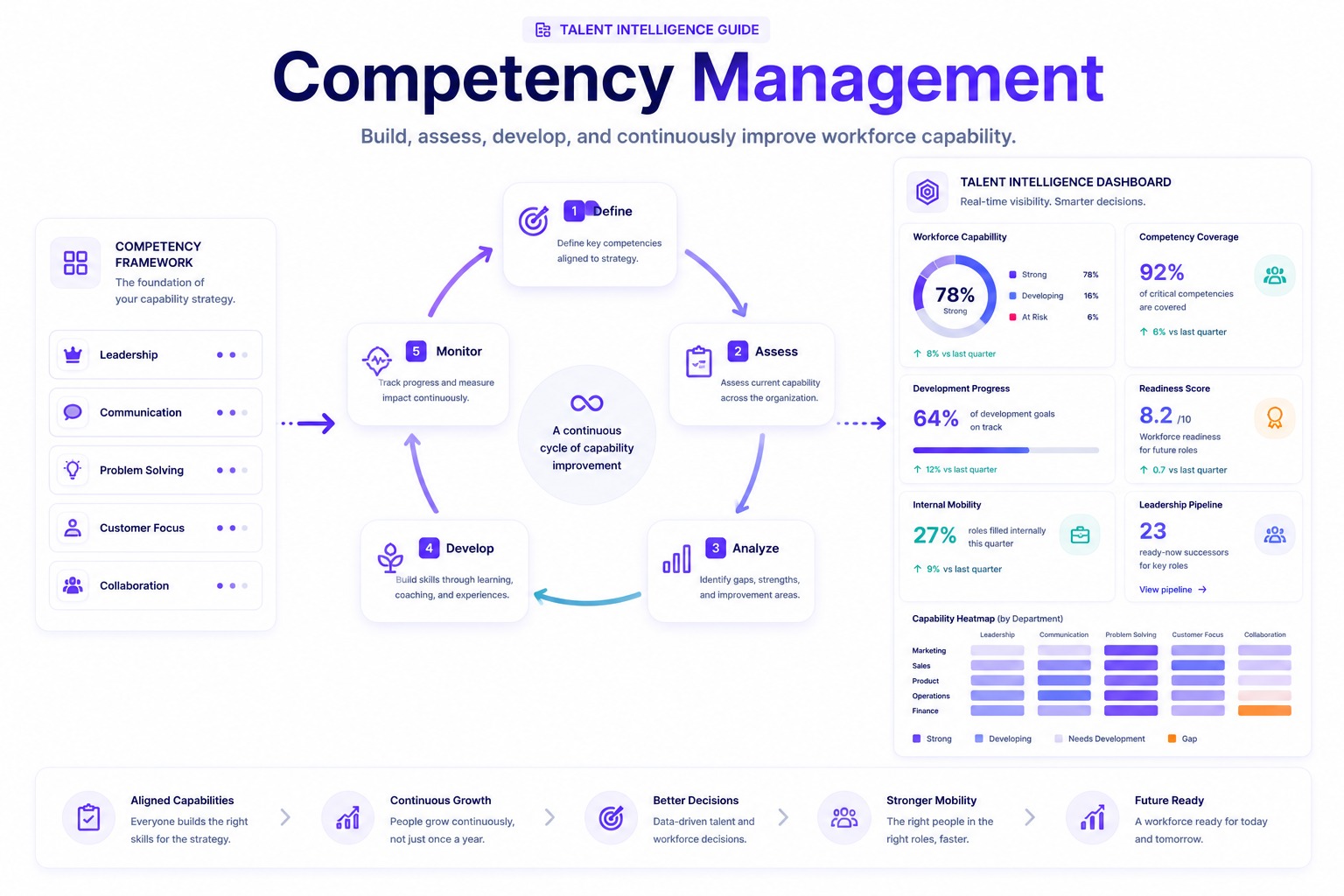
An effective Competency Management process typically follows five stages.
Define
Identify the competencies required for each role using a competency framework.
Assess
Evaluate current employee competency levels through self-assessments, manager reviews, or skill assessments.
Analyze
Identify competency gaps across teams, departments, and the organization.
Develop
Create targeted learning plans, mentoring opportunities, coaching programs, and career pathways.
Monitor
Track competency growth over time and adjust development priorities as business needs evolve.
Competency Management is a continuous cycle rather than an annual HR activity.
Why Competency Management Matters
Organizations that actively manage competencies can:
- Improve workforce capability.
- Prioritize learning investments.
- Support internal mobility.
- Strengthen succession planning.
- Increase leadership readiness.
- Reduce external hiring costs.
- Align workforce capabilities with business strategy.
Instead of reacting to talent shortages, they prepare for them.
Common Challenges
Many organizations struggle because they:
- Keep competency data in disconnected spreadsheets.
- Use inconsistent assessment criteria.
- Conduct assessments only once a year.
- Fail to connect competency data with employee development.
- Never review competency frameworks as business needs change.
Without continuous management, competency data quickly becomes outdated.
From Competency Management to Talent Intelligence
Competency Management provides structured workforce data.
Talent Intelligence transforms that data into strategic insights.
Instead of simply tracking competency ratings, leaders gain visibility into:
- Workforce capability trends.
- Future skill shortages.
- Internal mobility opportunities.
- Promotion readiness.
- Critical talent risks.
Competency Management creates the foundation.
Talent Intelligence helps organizations make better decisions with it.
Best Practices
Successful organizations:
- Build competency frameworks before assessments.
- Use standardized proficiency scales.
- Review competencies regularly.
- Connect assessments to development plans.
- Measure progress over time instead of treating assessments as isolated events.
- Use workforce data to support strategic planning.
Conclusion
Competency Management is more than evaluating employee skills.
It is the continuous process of ensuring the organization has the capabilities needed to achieve its strategy.
When organizations move beyond one-time assessments and actively manage competencies, they gain better visibility, stronger workforce readiness, and more informed talent decisions.
Frequently Asked Questions
What is Competency Management?
Competency Management is the continuous process of defining, assessing, developing, and monitoring employee competencies to support organizational goals.
Why is Competency Management important?
It helps organizations identify capability gaps, prioritize development, improve workforce readiness, and align talent with business strategy.
How is Competency Management different from Competency Assessment?
Competency Assessment measures current competency levels, while Competency Management uses those assessments to continuously develop and manage workforce capability.
Can Competency Management be managed with spreadsheets?
Small organizations may start with spreadsheets, but growing businesses often adopt Competency Management Software or Talent Intelligence platforms to improve visibility and scalability.
Related Articles
- What is Competency Framework?
- Employee Skills Assessment
- Skill Matrix
- Competency Management Software
- Talent Intelligence Platform
Explore what’s possible with SkillMAP
Frequently Asked Questions
What is Competency Management?
Competency Management is the continuous process of defining, assessing, developing, and monitoring employee competencies to support organizational goals.
Why is Competency Management important?
It helps organizations identify capability gaps, prioritize development, improve workforce readiness, and align talent with business strategy.
How is Competency Management different from Competency Assessment?
Competency Assessment measures current competency levels, while Competency Management uses those assessments to continuously develop and manage workforce capability.
Can Competency Management be managed with spreadsheets?
Small organizations may start with spreadsheets, but growing businesses often adopt Competency Management Software or Talent Intelligence platforms to improve visibility and scalability.