Quick Takeaways
A Competency Framework defines the capabilities required for success, while a Skill Matrix visualizes the skills employees currently possess. Organizations need both to make effective talent decisions.
- Competency Framework defines expectations.
- Skill Matrix measures current workforce capability.
- The two tools complement rather than replace each other.
- Together they create the foundation for Talent Intelligence.
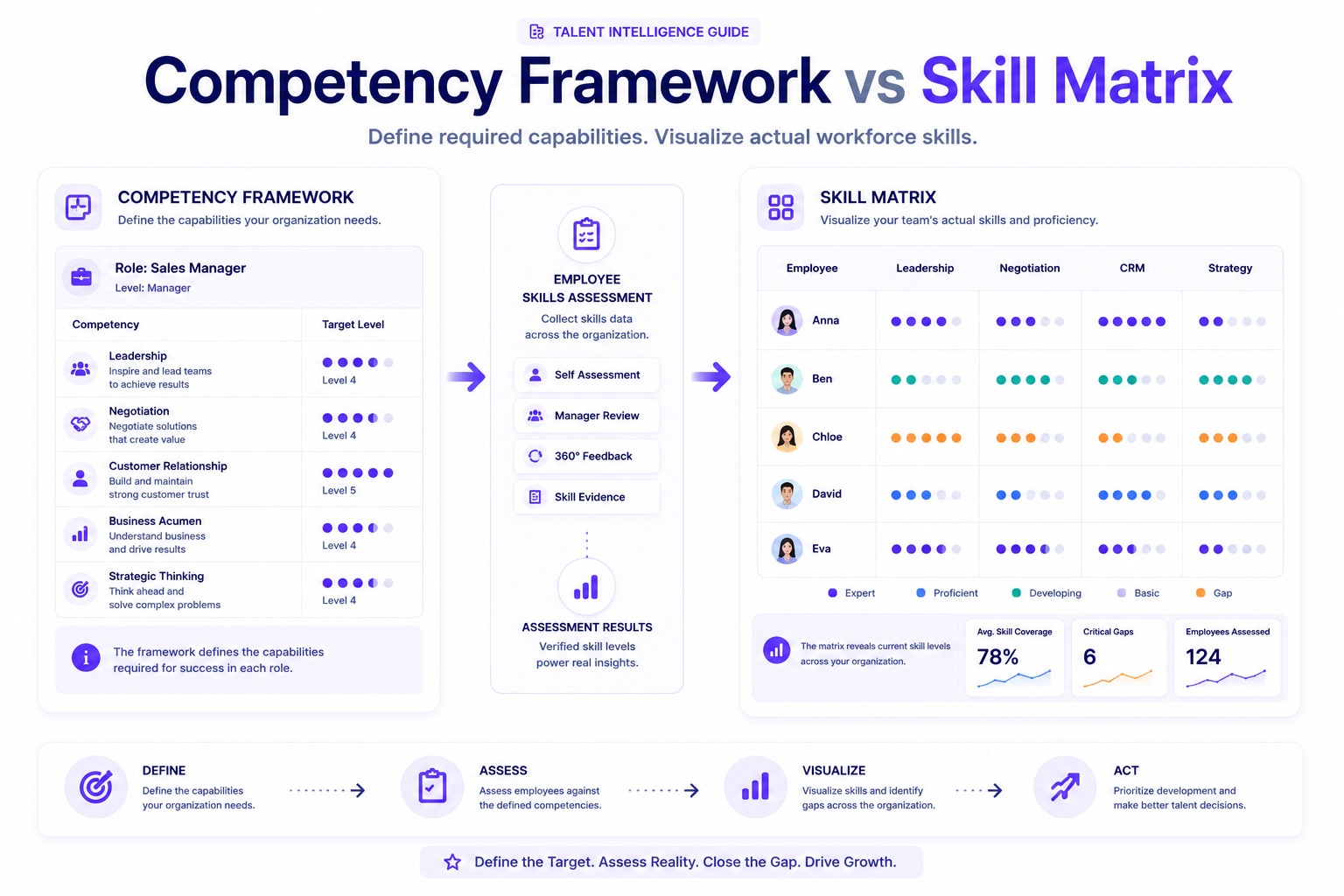
Competency Framework vs Skill Matrix
Many organizations use the terms Competency Framework and Skill Matrix interchangeably.
They shouldn’t.
Although both are used to understand workforce capability, they answer completely different questions.
A Competency Framework defines what capabilities employees should have.
A Skill Matrix shows what capabilities employees actually have today.
Understanding the difference helps organizations build more effective assessment, development, and workforce planning processes.
What Is a Competency Framework?
A Competency Framework defines the competencies required for success in a role, team, or organization.
These competencies often include:
- Technical competencies
- Functional competencies
- Behavioral competencies
- Leadership competencies
Think of it as the organization’s blueprint for workforce capability.
It defines the destination.
What Is a Skill Matrix?
A Skill Matrix is a visual representation of employee skills and proficiency levels.
Instead of defining expectations, it captures reality.
A Skill Matrix helps organizations answer questions such as:
- Who has which skills?
- Where are the capability gaps?
- Which teams need development?
- Who can support new projects?
It provides a snapshot of current workforce capability.
Competency Framework vs Skill Matrix
| Competency Framework | Skill Matrix |
|---|---|
| Defines required competencies | Visualizes current skills |
| Strategic foundation | Operational view |
| Built before assessments | Built using assessment results |
| Focuses on roles | Focuses on people |
| Supports career architecture | Supports workforce visibility |
| Changes infrequently | Updated continuously |
The easiest way to think about it is:
Competency Framework tells you what good looks like.
Skill Matrix tells you where you are today.
Which Should Come First?
Organizations should always start with a Competency Framework.
Without clearly defining the competencies required for each role, there is no consistent way to assess employees or build a meaningful Skill Matrix.
A common sequence looks like this:
- Build a Competency Framework.
- Assess employee competencies.
- Create a Skill Matrix.
- Identify skill gaps.
- Plan development actions.
- Monitor progress continuously.
Each step builds on the previous one.
Can a Skill Matrix Replace a Competency Framework?
No.
A Skill Matrix can only visualize skills that have already been defined.
Without a Competency Framework:
- Managers use different evaluation standards.
- Skill ratings become inconsistent.
- Development priorities become unclear.
- Workforce planning becomes unreliable.
The framework provides the rules.
The matrix provides the evidence.
How They Work Together
The strongest organizations use both tools together.
The Competency Framework establishes a common language for capability.
The Skill Matrix translates that framework into workforce data.
Together they enable organizations to:
- Identify capability gaps.
- Prioritize learning investments.
- Support internal mobility.
- Build succession pipelines.
- Improve workforce planning.
- Make better talent decisions.
Neither tool delivers its full value alone.
From Framework to Talent Intelligence
A modern competency strategy follows a connected workflow.
Competency Framework
↓
Employee Skills Assessment
↓
Skill Matrix
↓
Skill Gap Analysis
↓
Competency Management
↓
Talent Intelligence
Each stage adds more context and turns workforce data into actionable insight.
Common Mistakes
Organizations often struggle because they:
- Build a framework but never assess employees.
- Create Skill Matrices without standardized competencies.
- Treat the Skill Matrix as a one-time spreadsheet.
- Fail to update competency requirements as business needs evolve.
Both the framework and the matrix require continuous maintenance.
Conclusion
A Competency Framework and a Skill Matrix solve different problems.
The framework defines what capabilities the organization needs.
The matrix shows what capabilities the workforce currently has.
Together they provide the foundation for competency management, workforce planning, and Talent Intelligence.
Organizations don’t have to choose one over the other.
The most successful organizations build both—and use them together.
Frequently Asked Questions
What is the difference between a Competency Framework and a Skill Matrix?
A Competency Framework defines the competencies required for success, while a Skill Matrix visualizes employees’ current skills and proficiency levels.
Which should organizations create first?
Organizations should build a Competency Framework before creating a Skill Matrix.
Can a Skill Matrix replace a Competency Framework?
No. A Skill Matrix depends on clearly defined competencies to provide meaningful insights.
Why do organizations need both?
Together they help organizations assess workforce capability, identify gaps, prioritize development, and support strategic talent decisions.
Related Articles
- What Is Competency Framework?
- Competency Management
- Employee Skills Assessment
- Skill Matrix
- Talent Intelligence Platform
Explore what’s possible with SkillMAP
Frequently Asked Questions
What is the difference between a Competency Framework and a Skill Matrix?
A Competency Framework defines the competencies required for success, while a Skill Matrix visualizes employees' current skills and proficiency levels.
Which should organizations build first?
Organizations should build a Competency Framework before creating a Skill Matrix.
Can a Skill Matrix replace a Competency Framework?
No. A Skill Matrix depends on clearly defined competencies to provide meaningful insights.
Why do organizations need both?
Together they help organizations assess workforce capability, identify gaps, prioritize development, and support strategic talent decisions.