Quick Takeaways
A Career Path is a structured progression of roles, responsibilities, and competencies that helps employees understand how they can grow within an organization.
- Career Paths provide visibility into future growth opportunities.
- Effective Career Paths are built on competency frameworks.
- Skill Gap Analysis helps identify development priorities for the next role.
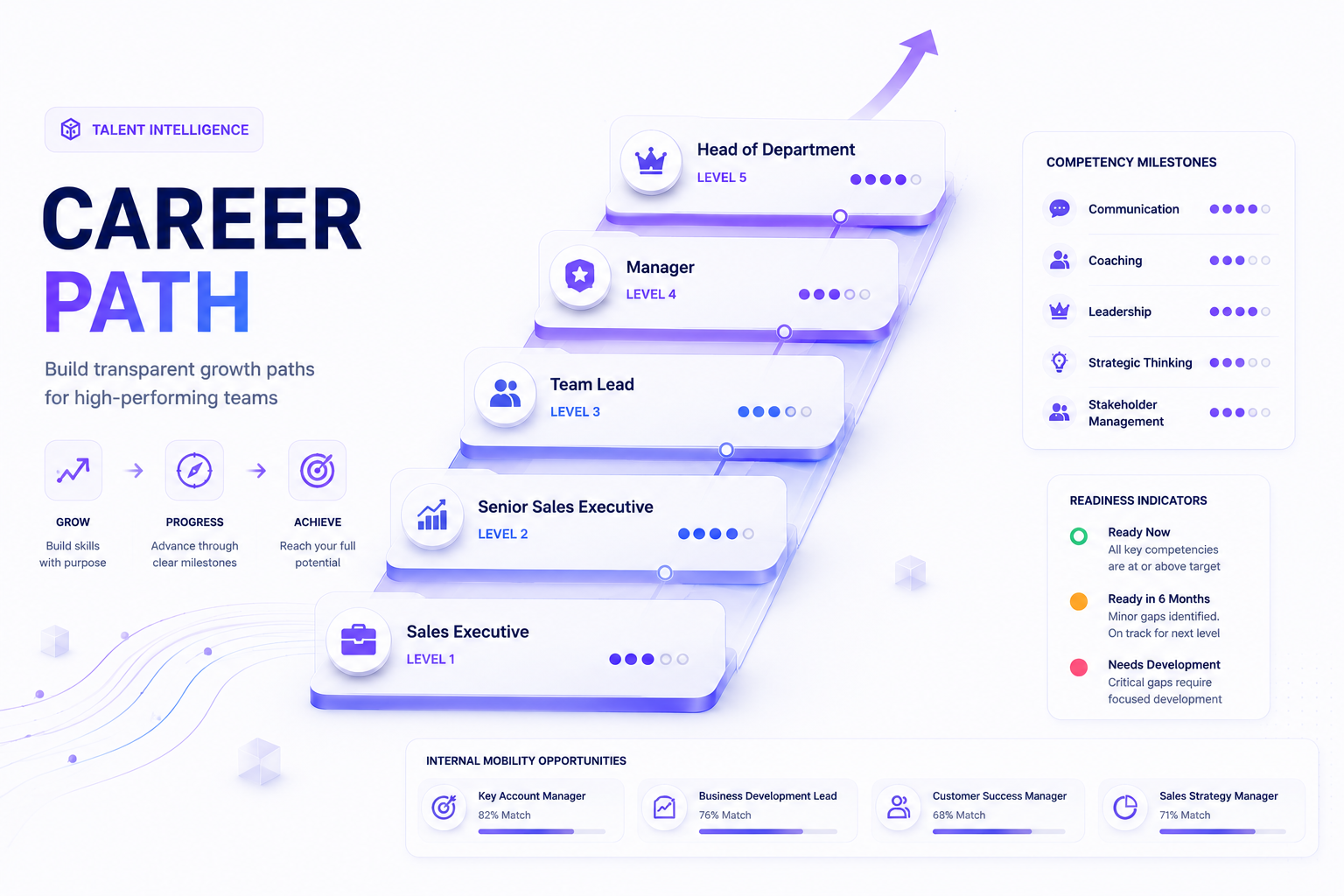
What Is a Career Path?
One of the most common reasons employees leave an organization is not compensation.
It is uncertainty.
Many employees simply do not know what opportunities exist beyond their current role.
At the same time, managers often struggle to answer questions such as:
What does an employee need to develop before becoming ready for the next role?
This is where Career Paths become important.
A Career Path is a structured roadmap that defines how employees can grow within an organization, including the roles they may progress into and the competencies required to reach each stage.
Instead of relying on assumptions or tenure, Career Paths provide a transparent framework for professional growth.
Why Are Career Paths Important?
As organizations grow, employees expect more than competitive compensation.
They want clarity.
Employees want to know:
- What future opportunities exist
- What role they can progress into next
- Which skills they need to develop
- How promotion decisions are made
Without clear Career Paths, organizations often experience:
- Lower employee engagement
- Higher turnover
- Unclear promotion criteria
- Limited internal mobility
- Increased reliance on external hiring
Career Paths help create alignment between employee aspirations and business needs.
Career Path vs Promotion
These terms are often used interchangeably, but they are not the same thing.
| Promotion | Career Path |
|---|---|
| A single event | A long-term journey |
| Focuses on job title changes | Focuses on capability growth |
| Often tied to compensation | Tied to development and readiness |
| Outcome-focused | Progress-focused |
A promotion answers:
What role did someone receive?
A Career Path answers:
What capabilities must someone develop to reach the next role?
This distinction is critical for growing organizations.
What Does a Career Path Look Like?
Consider a Sales organization.
A Career Path may look like this:
Sales Executive
↓
Senior Sales Executive
↓
Sales Team Lead
↓
Sales Manager
↓
Head of Sales
Each transition requires new capabilities.
For example:
| Role Transition | New Competencies Required |
|---|---|
| Executive → Senior | Account management, negotiation |
| Senior → Team Lead | Coaching, communication |
| Team Lead → Manager | Strategic thinking, forecasting |
| Manager → Head of Sales | Leadership, organizational planning |
Career growth is not simply about doing more work.
It is about developing new capabilities.
Career Paths Require Competency Frameworks
Many organizations create career ladders based solely on job titles.
This approach often creates confusion.
Effective Career Paths are built on a clear Competency Framework.
A competency framework defines:
- Required knowledge
- Critical skills
- Expected behaviors
- Proficiency levels
Instead of saying:
Perform well and you may be promoted.
Organizations can say:
To become a Team Lead, you must demonstrate Level 3 proficiency in Coaching, Communication, and Stakeholder Management.
This creates transparency and fairness.
Career Paths and Skill Gap Analysis
Knowing the next role is only part of the equation.
Organizations also need to understand:
How far away is an employee from becoming ready?
This is where Skill Gap Analysis becomes valuable.
For example:
A future Team Lead role may require:
| Competency | Required Level |
|---|---|
| Coaching | Level 3 |
| Communication | Level 3 |
| Stakeholder Management | Level 2 |
Current employee assessment:
| Competency | Current Level |
|---|---|
| Coaching | Level 2 |
| Communication | Level 2 |
| Stakeholder Management | Level 2 |
The identified gaps become the basis for development plans.
This transforms career growth from guesswork into a measurable process.
Common Career Path Mistakes
Focusing Only on Job Titles
Many organizations define future roles without defining required capabilities.
Employees understand where they can go but not how to get there.
Using Tenure as a Promotion Criterion
Time in role does not necessarily indicate readiness.
Career progression should be based on demonstrated competencies.
Creating Overly Complex Frameworks
Some organizations attempt to define hundreds of competencies across dozens of roles.
This often becomes difficult to maintain.
Start small and focus on critical positions.
Failing to Update Career Paths
Capability requirements evolve as organizations grow.
Career frameworks should evolve alongside business strategy.
Career Paths and Internal Mobility
One of the most valuable outcomes of Career Path visibility is stronger internal mobility.
When organizations understand employee capabilities and aspirations, they can identify internal candidates for new opportunities before hiring externally.
Benefits include:
- Reduced recruitment costs
- Faster onboarding
- Higher employee retention
- Better workforce utilization
Employees gain visibility into future opportunities while organizations gain access to a stronger internal talent pipeline.
Career Paths and Workforce Readiness
Career Paths are not only useful for employees.
They are equally valuable for leadership teams.
Organizations can use Career Path data to answer questions such as:
- How many employees are ready for the next role?
- Which critical positions have no successors?
- Which teams face leadership pipeline risks?
- Where should development investments be prioritized?
This shifts Career Paths from an HR initiative to a workforce planning capability.
From Career Paths to Talent Intelligence
Traditional career development focuses on individual growth.
Talent Intelligence expands the perspective.
Instead of asking:
What role does this employee want next?
Organizations begin asking:
- Who is ready for future leadership positions?
- Which teams lack succession coverage?
- Where are capability gaps concentrated?
- How prepared is the workforce for future growth?
This is where Career Path data becomes strategic business intelligence.
Explore How SkillMAP Supports Career Development
Most organizations track employee performance.
Few can visualize career readiness across an entire workforce.
SkillMAP helps organizations:
- Build competency frameworks
- Assess workforce capabilities
- Identify skill gaps
- Design transparent career paths
- Measure workforce readiness
- Support internal mobility decisions
Instead of relying on spreadsheets and subjective evaluations, organizations gain a data-driven view of workforce growth potential.
This is where career development evolves into Talent Intelligence.
👉 Explore the SkillMAP self-serve demo
👉 Talk with the SkillMAP team about Career Development and Workforce Readiness
Frequently Asked Questions
What is a Career Path?
A Career Path is a structured progression of roles and competencies that guides employees toward future career opportunities within an organization.
How is a Career Path different from a promotion?
A promotion is a single career event, while a Career Path is a long-term development journey based on capability growth.
Why do organizations need Career Paths?
Career Paths improve employee engagement, increase transparency, and support internal talent development.
How does Skill Gap Analysis support Career Paths?
Skill Gap Analysis identifies the capabilities employees need to develop before becoming ready for their next role.