Quick Takeaways
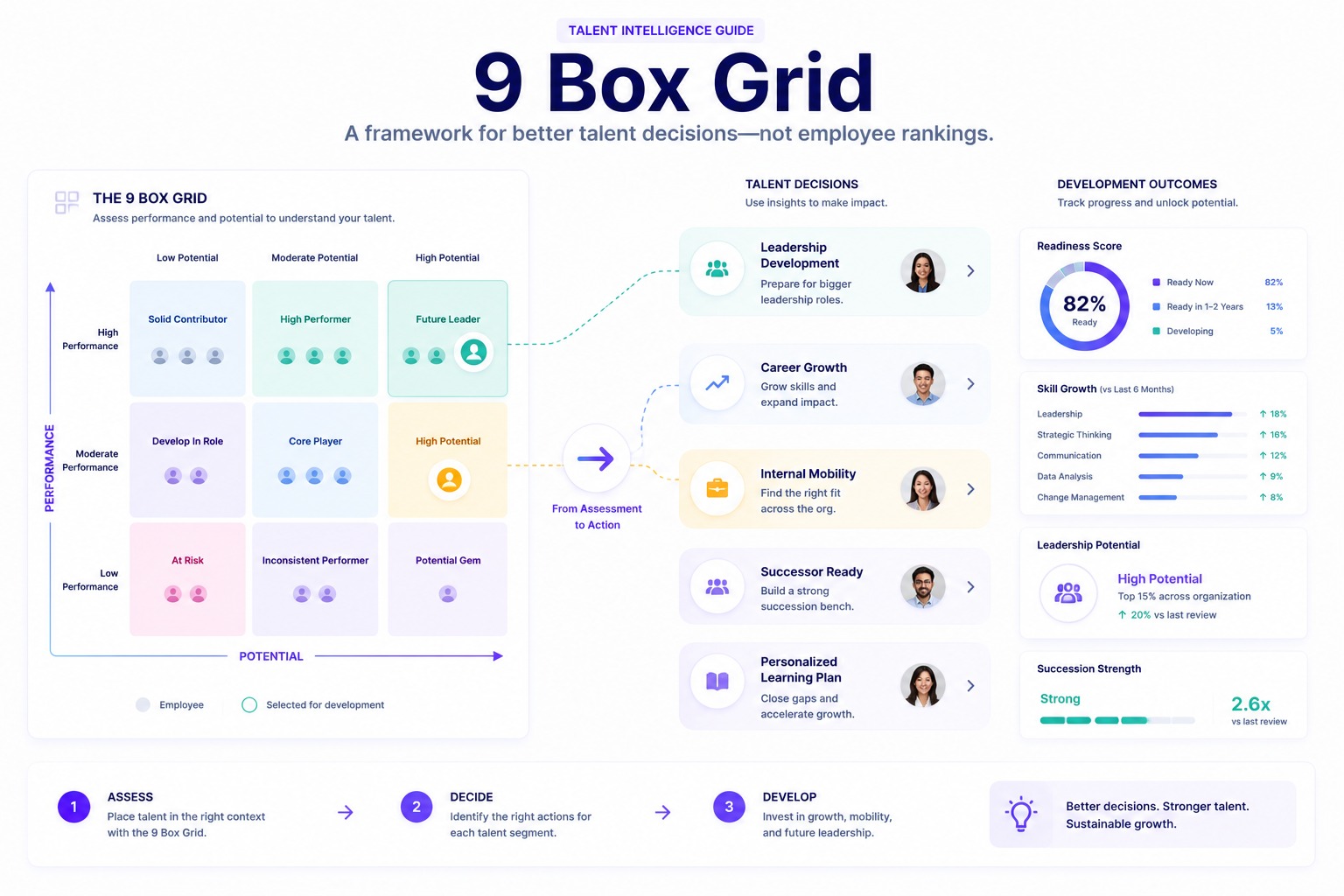
The 9 Box Grid is a talent assessment framework that evaluates employees based on performance and future potential. It helps organizations make more informed decisions about development, succession, and internal mobility.
- The 9 Box Grid supports talent decisions, not employee labels.
- Performance and potential should be evaluated separately.
- The framework is most effective when supported by objective workforce data.
- Talent Reviews become more consistent when using a structured framework.
What Is a 9 Box Grid?
When organizations discuss succession planning or leadership development, one framework appears again and again:
The 9 Box Grid.
Despite its popularity, it is also one of the most misunderstood talent management tools.
Many employees see it as a ranking system.
Many managers use it to classify people.
Neither reflects its real purpose.
A 9 Box Grid is not designed to label employees.
It is designed to help organizations make better decisions about developing talent.
The goal is not to answer:
“Who are our best employees?”
Instead, it helps answer:
“Who should we invest in, and how should we develop them?”
That difference is what makes the framework valuable.
What Is a 9 Box Grid?
A 9 Box Grid is a talent assessment framework that evaluates employees using two dimensions:
- Current Performance
- Future Potential
Combining these dimensions creates nine different talent segments.
Rather than producing a score, the framework helps leaders discuss development priorities.
For example:
- Who is ready for promotion?
- Who needs coaching?
- Who could become a future leader?
- Who performs well but may not want leadership responsibilities?
The emphasis is on future decisions—not past evaluation.
Understanding the Two Dimensions
Performance
Performance measures what an employee has already delivered.
It often considers:
- Business results
- KPI achievement
- Quality of work
- Goal completion
- Behavioral expectations
Performance is generally supported by Performance Reviews.
Potential
Potential measures an employee’s ability to take on greater responsibility in the future.
Potential often considers:
- Learning agility
- Leadership capability
- Strategic thinking
- Adaptability
- Growth mindset
- Influence across teams
Unlike performance, potential is forward-looking.
An employee may perform exceptionally today but have limited interest in leadership.
Another employee may have average performance while demonstrating exceptional long-term potential.
The 9 Box Grid Explained
| Performance ↓ / Potential → | Low | Medium | High |
|---|---|---|---|
| High Performance | Reliable Contributor | Strong Performer | Future Leader |
| Medium Performance | Inconsistent Contributor | Core Talent | Emerging Leader |
| Low Performance | Performance Concern | Development Needed | Untapped Potential |
The labels vary between organizations.
What matters is the discussion behind each placement.
The framework is intended to guide development conversations—not define careers.
Why Organizations Use the 9 Box Grid
Growing organizations need a structured way to discuss talent.
Without one, decisions often rely on manager opinions or recent performance.
The 9 Box Grid creates a common language for leadership discussions.
It helps organizations:
- Identify future leaders
- Prioritize development investment
- Support succession planning
- Improve internal mobility
- Reduce subjective decision-making
- Build stronger leadership pipelines
Instead of asking each manager to identify “top talent,” the organization evaluates employees using shared criteria.
Common Mistakes
The framework is powerful, but only when used correctly.
Common mistakes include:
Treating it as a ranking system
Employees are not competing against one another.
The grid should guide development—not create winners and losers.
Confusing performance with potential
High performers are not automatically high-potential employees.
Leadership readiness requires additional capabilities beyond technical excellence.
Making decisions from one manager’s opinion
Talent discussions should involve multiple leaders and HR.
Calibration improves fairness and consistency.
Never updating placements
People grow. Skills improve. Business needs change.
The grid should evolve alongside the workforce.
The Role of Talent Reviews
The 9 Box Grid is most valuable during Talent Reviews.
Performance Reviews provide one important input.
Talent Reviews provide the context.
Leadership teams discuss:
- Business priorities
- Leadership pipeline
- Succession risks
- Skills availability
- Employee aspirations
- Organizational capability
The grid becomes a conversation framework rather than a performance report.
Why Spreadsheets Become a Limitation
Many organizations maintain their 9 Box Grid in PowerPoint or Excel.
That works for small teams.
As organizations grow, challenges appear:
- Outdated employee information
- Inconsistent assessments
- Multiple versions
- Limited visibility
- Difficult calibration
More importantly, spreadsheets rarely connect performance with skills, competencies, readiness, or career aspirations.
This creates blind spots in talent decisions.
How Talent Intelligence Improves the 9 Box Grid
Modern Talent Intelligence Platforms enrich the 9 Box Grid with real workforce data.
Instead of relying solely on manager opinions, leaders can evaluate employees using:
- Skills assessments
- Competency data
- Career aspirations
- Readiness indicators
- Internal mobility opportunities
- Succession pipelines
- Workforce capability insights
The discussion shifts from subjective judgments to evidence-based decisions.
The grid remains the framework. Talent Intelligence provides the data.
Conclusion
The 9 Box Grid has remained popular for decades because its purpose is simple.
It helps organizations have better conversations about talent.
Its value does not come from placing employees into boxes.
Its value comes from making better decisions about development, succession, and future leadership.
When supported by accurate workforce data, the 9 Box Grid becomes more than a talent matrix.
It becomes a practical decision-making framework for growing organizations.
Related Articles
- Talent Review vs Performance Review
- What Is Succession Planning?
- What Is Internal Mobility?
- Employee Skills Assessment
- What Is Talent Intelligence?
Frequently Asked Questions
What is a 9 Box Grid?
The 9 Box Grid is a talent assessment framework that evaluates employees based on current performance and future potential.
Is the 9 Box Grid used for performance reviews?
No. Performance Reviews provide input, but the 9 Box Grid is primarily used during Talent Reviews to support development and succession decisions.
What is the difference between performance and potential?
Performance reflects what an employee has achieved. Potential reflects what they may be capable of achieving in future roles.
Is the 9 Box Grid still relevant today?
Yes. Many organizations continue to use it, especially when combined with skills data and Talent Intelligence to improve objectivity and decision-making.