Quick Takeaways
Employee skills assessment is a structured process for evaluating workforce capabilities against business needs. It helps organizations identify strengths, uncover skill gaps, and make better hiring, development, and internal mobility decisions.
- Skills assessments provide visibility into workforce capability.
- Assessments should support business decisions rather than performance ratings.
- Continuous assessment is more valuable than annual evaluations.
- Modern Talent Intelligence platforms automate skill visibility.
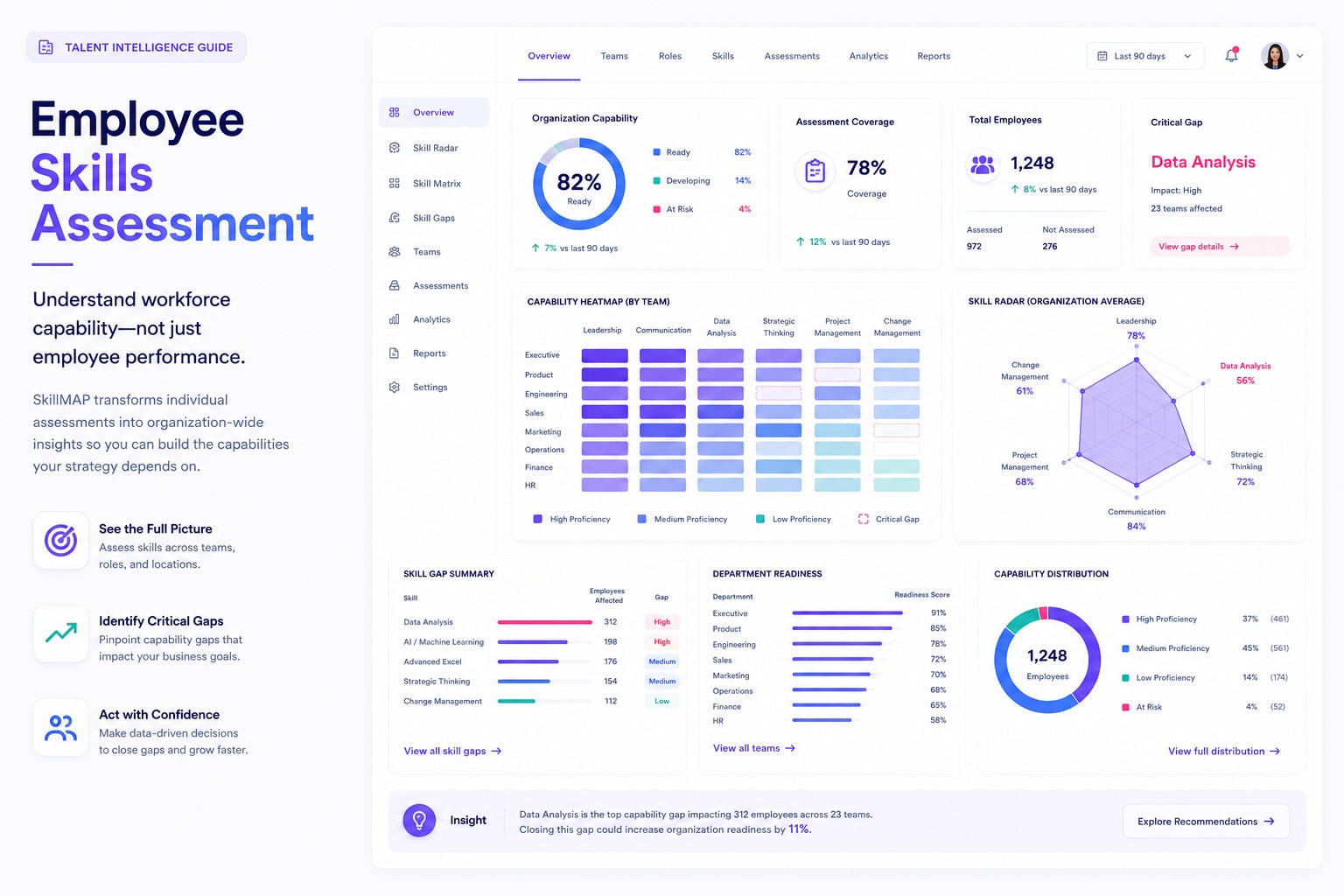
Employee Skills Assessment: A Practical Guide for Growing Companies
Most companies already evaluate employee performance.
Far fewer actually understand the skills their workforce possesses.
These are not the same thing.
An employee may consistently meet performance expectations while lacking critical skills needed for future projects. Another employee may have valuable capabilities that remain invisible because nobody has documented or assessed them.
An employee skills assessment helps organizations answer a much more strategic question:
Do we have the skills required to execute our business strategy?
Instead of becoming another HR exercise, skills assessments should become a source of organizational intelligence.
What Is an Employee Skills Assessment?
An employee skills assessment is the structured process of evaluating the knowledge, technical skills, and behavioral capabilities employees possess relative to their current or future roles.
Unlike traditional performance reviews, a skills assessment focuses on capability, not outcomes.
| Performance Review | Skills Assessment |
|---|---|
| Measures results | Measures capability |
| Looks backward | Looks at current and future readiness |
| Focuses on objectives | Focuses on skills |
| Supports compensation | Supports talent decisions |
Both are valuable — but they answer different business questions.
Why Employee Skills Assessment Matters
As organizations grow, workforce visibility becomes increasingly difficult.
Managers know their own teams.
HR has employee records.
Executives know business priorities.
But very few organizations can confidently answer questions like:
- Which teams lack critical skills?
- Who is ready for promotion?
- Where are the biggest capability gaps?
- Which employees could move into new roles?
- What skills should we hire versus develop internally?
Without reliable assessment data, these decisions rely heavily on assumptions.
Skills Assessment Is About the Organization — Not Just Individuals
One common misconception is that employee skills assessments exist to score employees.
In reality, the goal is to understand organizational capability.
Imagine your company plans to launch an AI-powered product.
Before hiring aggressively, leadership needs to know:
- How many employees already possess AI-related skills?
- Which teams can be upskilled quickly?
- Where are the largest capability gaps?
- Which managers already have the expertise to mentor others?
This perspective transforms skills assessment from an HR task into a strategic planning tool.
Common Types of Employee Skills Assessment
Organizations typically combine several assessment methods.
| Assessment Method | Best Used For |
|---|---|
| Self-assessment | Employee reflection |
| Manager assessment | Validation and calibration |
| Practical tests | Technical roles |
| Certifications | Compliance requirements |
| Peer feedback | Collaboration skills |
| Project evidence | Demonstrated capability |
Using multiple data sources generally produces more reliable insights than relying on a single assessment.
A Five-Step Employee Skills Assessment Process
Step 1: Define Required Skills
Start by identifying the skills required for each role.
These often come from a competency framework or role profile.
Step 2: Assess Current Capability
Collect assessments from employees, managers, or objective testing.
Consistency matters more than complexity.
Step 3: Identify Skill Gaps
Compare current proficiency against target proficiency.
This highlights where development or hiring is needed.
For a deeper explanation, see our guide to Skill Gap Analysis.
Step 4: Prioritize Development
Not every gap requires immediate action.
Prioritize skills that directly affect business objectives.
Step 5: Monitor Progress
Skills evolve continuously.
Assessment should therefore become an ongoing process rather than an annual event.
Common Challenges
Many organizations struggle because they:
- Use inconsistent evaluation criteria.
- Rely entirely on spreadsheets.
- Conduct assessments only once a year.
- Focus only on technical skills.
- Fail to connect assessment data to business decisions.
As the workforce grows, these challenges become increasingly difficult to manage manually.
From Skills Assessment to Talent Intelligence
Traditional assessments generate snapshots.
Talent Intelligence generates continuous visibility.
Instead of asking:
“How did employees score this year?”
Organizations begin asking:
- Which skills are increasing?
- Which teams are falling behind?
- Where is future leadership emerging?
- Which employees are ready for Internal Mobility?
- What capability risks threaten future growth?
This shift changes assessment from a reporting exercise into an ongoing decision-support system.
When Is Software Worth Considering?
Spreadsheets work for small teams.
As organizations grow, maintaining assessment data becomes increasingly complex.
Dedicated platforms can help organizations:
- Standardize assessment criteria.
- Combine employee and manager evaluations.
- Visualize workforce capability.
- Detect skill gaps automatically.
- Track capability trends over time.
- Support internal mobility and succession planning.
Rather than replacing managers, software provides leaders with the visibility needed to make better talent decisions.
Conclusion
Employee skills assessments are not about assigning scores.
They are about understanding whether your workforce has the capabilities needed to achieve business goals.
Organizations that assess skills continuously gain better visibility, make more informed talent decisions, and respond faster to changing business needs.
The real value lies not in the assessment itself, but in the decisions it enables.
Related Articles
- What Is Skill Gap Analysis?
- What Is a Skills Inventory?
- Employee Competency Assessment Software
- What Is Talent Intelligence?
- Competency Management Software
Explore What’s Possible with SkillMAP
Frequently Asked Questions
What is an employee skills assessment?
An employee skills assessment evaluates an employee's knowledge, technical abilities, and workplace skills relative to job requirements.
Why is employee skills assessment important?
It helps organizations understand workforce capability, identify skill gaps, and make better decisions around hiring, development, and internal mobility.
How often should companies assess employee skills?
Many growing organizations move toward continuous or quarterly updates instead of relying solely on annual assessments.
What is the difference between skills and competency assessment?
Skills assessments focus on specific technical or functional abilities, while competency assessments evaluate broader behavioral and role-based capabilities.