Quick Takeaways
A Skill Matrix is a visual tool that helps organizations map employee skills, identify capability gaps, and make better workforce decisions.
- A Skill Matrix makes workforce capabilities visible.
- Organizations use Skill Matrices to identify skill gaps and prioritize development.
- A Skill Matrix often serves as the foundation for Skills Inventory and Talent Intelligence initiatives.
What Is a Skill Matrix?
As organizations grow, one question becomes increasingly difficult to answer:
Who has which skills within the organization?
Most companies know their organizational structure.
They know reporting lines.
They know job titles.
But when a new project requires specific capabilities, many organizations struggle to identify the right people quickly.
Skill data often lives in spreadsheets, manager notes, or individual memory.
This is where a Skill Matrix becomes valuable.
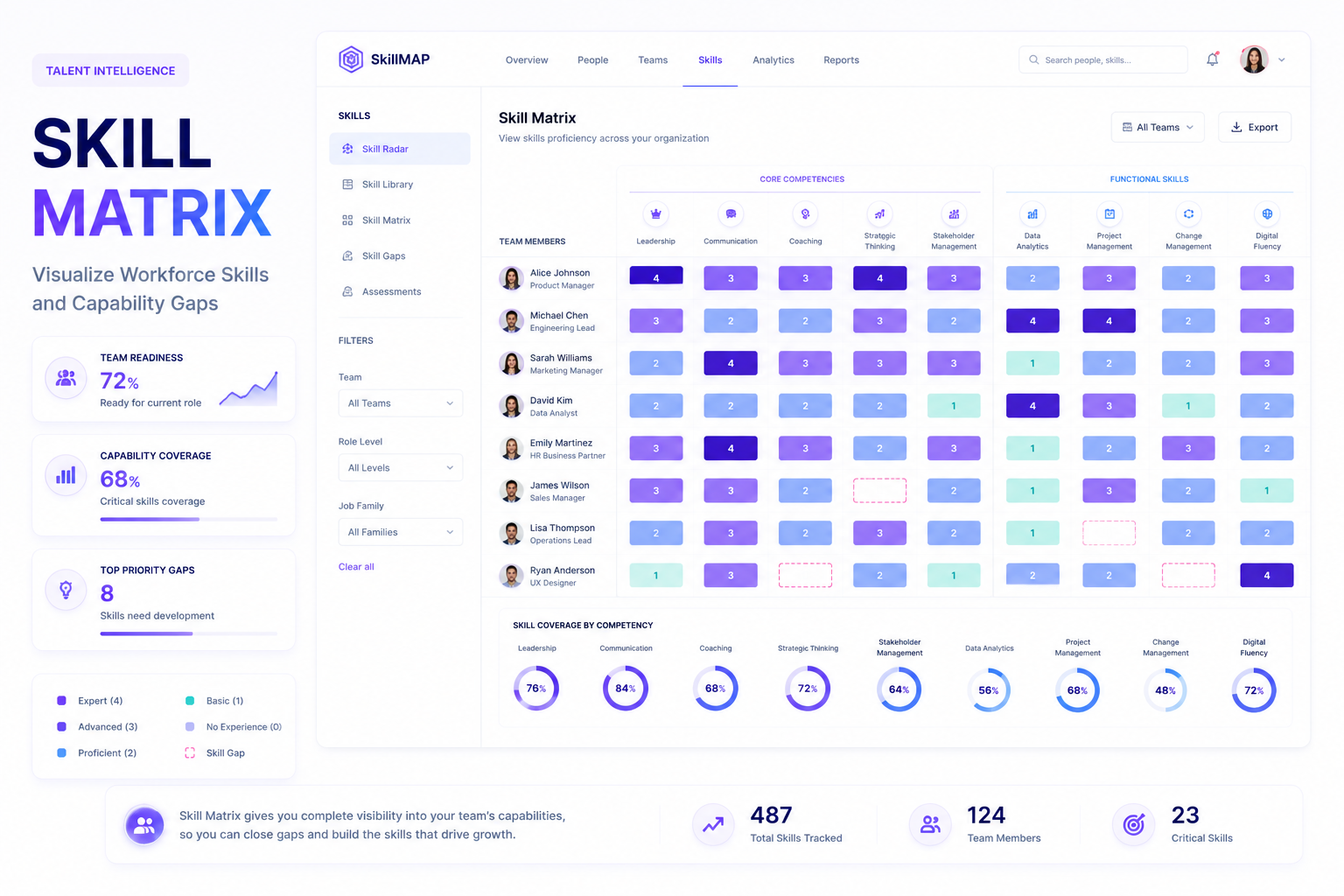
A Skill Matrix is a visual framework that maps employee skills and proficiency levels, helping organizations understand existing capabilities, identify skill gaps, and make informed workforce decisions.
Why Organizations Need a Skill Matrix
You cannot manage what you cannot see.
Without a Skill Matrix, organizations often face challenges such as:
- Limited visibility into workforce capabilities
- Difficulty identifying skill shortages
- Unfocused training investments
- Dependence on key individuals
- Unnecessary external hiring
A Skill Matrix transforms skill data into actionable workforce insights.
What Does a Skill Matrix Look Like?
A Skill Matrix is typically presented as a table.
For example:
| Employee | Data Analysis | Project Management | Communication |
|---|---|---|---|
| Anna | 3 | 2 | 3 |
| Ben | 2 | 3 | 2 |
| Chloe | 1 | 2 | 3 |
Where:
- Level 1 = Basic
- Level 2 = Proficient
- Level 3 = Advanced
This simple structure allows organizations to quickly understand workforce strengths and weaknesses.
Skill Matrix vs Skills Inventory
These two concepts are often confused.
| Skill Matrix | Skills Inventory |
|---|---|
| Visualization tool | Workforce capability system |
| Focuses on displaying skills | Focuses on managing skills data |
| Often used at team level | Can cover the entire organization |
| Easier to implement | More comprehensive |
Our article on What Is a Skills Inventory? explores how organizations build workforce-wide visibility into skills and capabilities.
How to Build a Skill Matrix
Step 1: Identify Critical Skills
Not every skill needs to be included.
Start with capabilities that directly impact business outcomes.
Examples include:
- Sales Forecasting
- Product Discovery
- Coaching
- Communication
- Strategic Thinking
Step 2: Define Proficiency Levels
A skill is only useful when proficiency expectations are clearly defined.
Many organizations use a structured Competency Framework to standardize skill definitions and performance expectations.
Step 3: Assess Current Capabilities
Organizations can gather capability data through:
- Self-assessments
- Manager assessments
- 360-degree feedback
- Competency assessment software
The objective is to create a reliable picture of current workforce capabilities.
Step 4: Visualize the Data
Once data is collected, the Skill Matrix helps organizations identify:
- Areas of strength
- Capability shortages
- High-potential employees
- Workforce risks
Skill Matrix and Skill Gap Analysis
One of the most common applications of a Skill Matrix is supporting Skill Gap Analysis.
For example:
An organization requires ten employees with advanced Data Analysis capabilities.
The Skill Matrix shows that only four employees currently meet the required proficiency level.
This gap becomes the basis for decisions related to:
- Training
- Talent development
- Recruitment
- Workforce planning
Skill Matrix and Workforce Planning
A Skill Matrix is not only useful for HR teams.
It is also an important component of Workforce Planning.
When organizations understand which capabilities already exist internally, they can make more informed decisions about future workforce needs.
Questions such as:
- Should we build or buy talent?
- Do we need training or recruitment?
- Which teams require capability investment?
can all be answered more effectively using workforce skill data.
Common Mistakes When Building a Skill Matrix
Including Too Many Skills
A matrix containing hundreds of skills quickly becomes difficult to maintain.
Focus on capabilities that matter most to business success.
Lack of Standardized Definitions
If managers interpret proficiency levels differently, data quality suffers.
Failing to Update the Matrix
Skills evolve over time.
A Skill Matrix should be reviewed and updated regularly.
From Skill Matrix to Talent Intelligence
A Skill Matrix is often the first step toward workforce visibility.
When combined with:
- Skills Inventory
- Skill Gap Analysis
- Workforce Planning
- Internal Mobility
organizations can begin building Talent Intelligence capabilities that support data-driven workforce decisions.
Explore How SkillMAP Visualizes Workforce Skills
SkillMAP helps organizations:
- Build competency frameworks
- Assess workforce capabilities
- Create visual Skill Matrices
- Identify skill gaps
- Support workforce planning
- Build Talent Intelligence using workforce data
Frequently Asked Questions
What is a Skill Matrix?
A Skill Matrix is a visual framework that maps employee skills and proficiency levels across a team or organization.
How is a Skill Matrix different from a Skills Inventory?
A Skill Matrix focuses on visualizing skills, while a Skills Inventory serves as a broader system for managing workforce capability data.