Quick Takeaways
Competency assessment tools help organizations evaluate employee capabilities, but the greatest value comes from turning assessment data into Talent Intelligence that supports workforce planning and talent decisions.
- Competency assessment is the starting point, not the destination.
- Spreadsheets work for small teams but don't scale.
- Talent Intelligence connects competency data to business decisions.
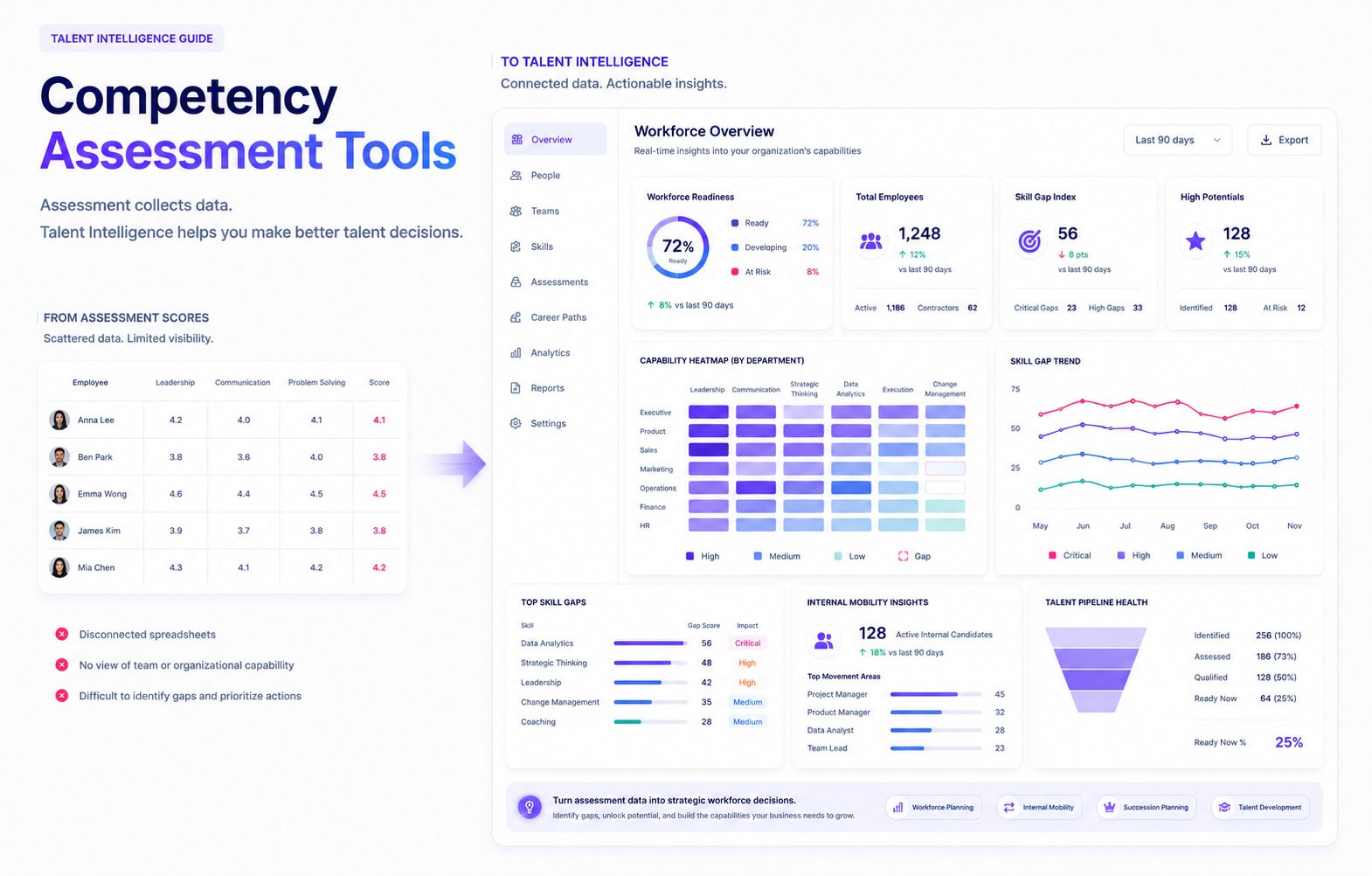
Most companies don’t have a competency assessment problem.
They have a talent visibility problem.
Every year, organizations invest significant time in competency assessments.
HR teams build competency frameworks.
Managers complete evaluations.
Scores are collected.
Reports are presented to leadership.
Everything appears to be working.
Then a CEO asks a simple question:
“If we double the size of this business next year, do we already have the people to support that growth?”
Silence.
Not because the company lacks data.
Because no one can see what that data actually means.
Most organizations already possess thousands of data points about employee competencies, skills, certifications, and performance.
Unfortunately, that information often lives across spreadsheets, forms, PDFs, and disconnected HR systems.
As a result, companies know how individual employees scored, but struggle to answer much more important questions.
- Which departments have the largest capability gaps?
- Where are our succession risks?
- Who is ready for a leadership role?
- Which positions could be filled internally instead of hiring externally?
- What capabilities will become critical over the next 12 months?
These questions cannot be answered by assessment scores alone.
They require something bigger.
They require Talent Intelligence.
Competency assessments generate workforce data.
Talent Intelligence transforms that data into decisions.
That shift explains why many growing organizations are no longer searching for software that simply digitizes performance reviews or competency evaluations.
They’re looking for platforms that help them understand the capabilities of their workforce—and make better talent decisions because of it.
What is a Competency Assessment Tool?
A competency assessment tool is software that helps organizations evaluate employee capabilities against predefined competency frameworks.
Most solutions support activities such as:
- Standardizing competency evaluations across departments.
- Collecting manager, employee, or 360-degree assessments.
- Measuring competency levels by role.
- Identifying gaps between current and expected capability.
- Producing reports for HR and leadership teams.
For many years, this was considered the end goal.
Conduct assessments.
Generate reports.
Move on until the next review cycle.
Today, that expectation has changed.
Organizations have realized that completing an assessment is only the beginning.
The real question is:
What happens after the assessment is finished?
If competency data sits inside spreadsheets or PDF reports until the next annual review, very little business value is created.
Modern organizations expect competency assessment tools to do more than record information.
They expect them to support workforce planning, learning and development, career growth, succession planning, and internal mobility.
In other words, they expect competency data to become actionable.
Why spreadsheets eventually stop working
Nearly every organization starts with Excel or Google Sheets.
And for good reason.
Spreadsheets are affordable, flexible, familiar, and easy to customize.
For smaller organizations, they’re often more than enough.
But as companies grow, spreadsheets begin creating new problems instead of solving existing ones.
HR teams spend hours consolidating files.
Different departments maintain different versions of competency frameworks.
Reports become increasingly difficult to produce.
Most importantly, spreadsheets capture only a snapshot of workforce capability instead of showing how it evolves over time.
The biggest cost isn’t administrative effort.
It’s the loss of talent visibility.
Without a reliable view of workforce capabilities, organizations struggle to make confident decisions about hiring, promotion, succession, and workforce planning.
Signs your organization has outgrown spreadsheets
Not every company needs dedicated competency assessment software.
However, if several of the following situations sound familiar, it may be time to rethink your approach.
- More than 100 employees participate in competency reviews.
- HR spends days consolidating assessment results.
- Different teams evaluate employees differently.
- Leadership regularly requests reports that require manual work.
- Competency data isn’t connected to learning or career development.
- Internal candidates are difficult to identify.
- Skills gaps are impossible to measure across the organization.
- Workforce planning relies more on assumptions than data.
These aren’t software problems.
They’re visibility problems.
And visibility is exactly where Talent Intelligence begins.
Types of Competency Assessment Tools
Not every competency assessment tool solves the same problem.
1. Spreadsheets
Spreadsheets remain the most common starting point.
They’re ideal for organizations that are building their first competency framework or running assessments for a small workforce.
However, as organizations grow, the limitations become increasingly obvious — multiple file versions, manual data consolidation, limited reporting, no historical tracking.
Spreadsheets are excellent for recording information. They are not designed to manage workforce capability.
2. Survey-Based Assessment Tools
Examples include Google Forms, Microsoft Forms, and Typeform.
These tools improve the assessment process by making it easier to collect responses.
But they cannot automatically answer questions like:
- Which business unit has the largest skills gap?
- Which employees are almost ready for leadership roles?
Collecting responses and generating workforce insight are two very different things.
3. HRIS with Competency Modules
Many HRIS platforms now include competency management features.
For many businesses, this is a significant improvement over spreadsheets.
However, most HRIS platforms were designed primarily to manage HR operations. Their competency features typically focus on documentation rather than strategic workforce decisions.
Capabilities such as Skills Intelligence, Internal Mobility, Career Pathing, Workforce Readiness, and Succession Planning are often limited or unavailable.
4. Talent Intelligence Platforms
Instead of asking:
“What competency score did this employee receive?”
Talent Intelligence asks questions like:
- Which teams are most prepared for future growth?
- What critical skills are missing across the organization?
- Which open positions could be filled internally?
- Where are the biggest succession risks?
Competency assessment still matters. But assessment becomes an input—not the final outcome.
How to evaluate a Competency Assessment Tool
Choosing software shouldn’t start with a feature checklist.
It should start with a business question.
What decisions should this platform help us make?
| Evaluation Criteria | Why It Matters |
|---|---|
| Competency Framework Support | Standardizes assessments across the organization. |
| Skills Management | Tracks both competencies and practical skills. |
| Skills Gap Analysis | Identifies capability gaps automatically. |
| Dashboards | Gives leaders a real-time view of workforce capability. |
| Career Path Support | Connects assessments with employee development. |
| Internal Mobility | Identifies internal candidates for new opportunities. |
| Workforce Analytics | Turns workforce data into business insights. |
| Integrations | Connects with HRIS, LMS, and other systems. |
| Security & Permissions | Protects sensitive workforce information. |
| Scalability | Continues to support the business as it grows. |
One simple question often separates modern platforms from traditional assessment software:
What happens immediately after an assessment is completed?
If the answer is “Generate a report” — you’re probably looking at assessment software.
If the answer is “Identify workforce risks, recommend development priorities, surface internal talent, and support planning” — you’re looking at Talent Intelligence.
Three common mistakes when choosing assessment software
Mistake 1: Digitizing Excel without improving decisions
Many organizations replace spreadsheets with software expecting transformation.
In reality, they’ve only changed where the data lives.
Technology alone doesn’t create better decisions. Better visibility does.
Mistake 2: Comparing feature lists instead of business outcomes
Leaders should ask:
- Will managers actually use it?
- Can HR operate it without constant support?
- Will executives receive insights they don’t have today?
A platform creates value through adoption and decision-making—not through the length of its feature list.
Mistake 3: Treating competency assessment as the final objective
Competency assessment is not the destination. It’s the foundation.
Organizations generate value only when competency data supports learning, career growth, workforce planning, succession planning, and internal mobility.
Competency Assessment Is Only the Beginning
Eventually, every leadership team asks the same question.
“Now that we’ve completed the assessment… what should we do next?”
A competency assessment tool can tell you:
- Sarah scored 4.2 out of 5.
- The Sales team averages 3.8.
- 95% of employees completed their assessments.
But business leaders need answers to questions like:
- Can we support next year’s growth with our current workforce?
- Which critical capabilities are missing across the organization?
- Who could step into leadership roles within the next 12 months?
Assessment scores alone cannot answer these questions.
That’s why organizations are increasingly moving beyond assessment software toward Talent Intelligence.
From Workforce Data to Workforce Decisions
Imagine two companies that complete competency assessments on the same day.
Company A
- Exports Excel files.
- Creates PDF reports.
- Archives the results.
- Waits for next year’s review cycle.
Six months later, very little has changed.
Company B
Competency data immediately helps HR leaders:
- Identify skills gaps across departments.
- Recommend targeted learning programs.
- Update workforce readiness dashboards.
- Surface internal candidates for open positions.
- Highlight succession risks.
- Support workforce planning for future business growth.
The assessment itself wasn’t better.
The difference was what happened after the assessment.
Which solution is right for your organization?
If you’re building your first competency framework, spreadsheets may be sufficient.
If your primary goal is digitizing assessments, an HRIS with competency functionality may be the logical next step.
But if your leadership team wants workforce data to support hiring, promotion, succession planning, internal mobility, and business strategy, you’ll likely need something more comprehensive.
Instead of asking “Which software has the most features?” ask “Which platform helps us make better talent decisions?”
Conclusion
Competency assessment tools play an important role in modern HR.
They standardize evaluations, improve consistency, reduce administrative effort, and provide a structured view of employee capability.
But organizations don’t create competitive advantage by collecting better assessment data.
They create advantage by making better workforce decisions.
This is why more organizations are shifting their focus from competency assessment software to Talent Intelligence Platforms.
Because the goal has never been to measure people.
The goal is to understand workforce capability well enough to grow the business with confidence.
Related Articles
- What Is Talent Intelligence?
- What Is Competency Management?
- What Is Skills Inventory?
- What Is Skill Gap Analysis?
- What Is Workforce Planning?
- What Is Workforce Analytics?
See SkillMAP in Action
👉 Explore SkillMAP Demo with sample data
See how competency, skills, and workforce data connect inside a Talent Intelligence Platform using interactive sample data—no signup required.
👉 Or talk with our team about competency assessment
FAQs
What is a competency assessment tool?
A competency assessment tool is software that helps organizations evaluate employee capabilities against predefined competency frameworks. Modern platforms also identify skills gaps, support employee development, and provide insights for workforce planning.
Is Excel enough for competency assessments?
Excel works well for smaller organizations or those just beginning to build competency frameworks. As workforce size and complexity increase, maintaining accurate data and generating meaningful insights becomes significantly more difficult.
What’s the difference between a competency assessment tool and an HRIS?
An HRIS primarily manages employee records, payroll, attendance, and administrative HR processes. A competency assessment tool focuses on evaluating workforce capability and supporting employee development.
Can a Talent Intelligence Platform replace competency assessment software?
Talent Intelligence Platforms include competency assessment as one component of a broader workforce intelligence strategy. They connect competency data with skills, workforce planning, career paths, succession planning, internal mobility, and analytics.
When should companies invest in competency assessment software?
Organizations should consider dedicated software when spreadsheets become difficult to maintain, competency data is scattered across multiple systems, or leadership needs workforce insights to support hiring, development, succession planning, and business growth.
Frequently Asked Questions
What is a competency assessment tool?
Software that helps organizations evaluate employee capabilities against predefined competency frameworks, with modern platforms also supporting workforce planning and talent decisions.
Is Excel enough for competency assessment?
Excel works for smaller organizations but becomes difficult to maintain as workforce size and complexity increase.
When should companies invest in dedicated software?
When spreadsheets are hard to maintain, data is scattered, or leadership needs workforce insights to support hiring, development, and succession planning.