Quick Takeaways
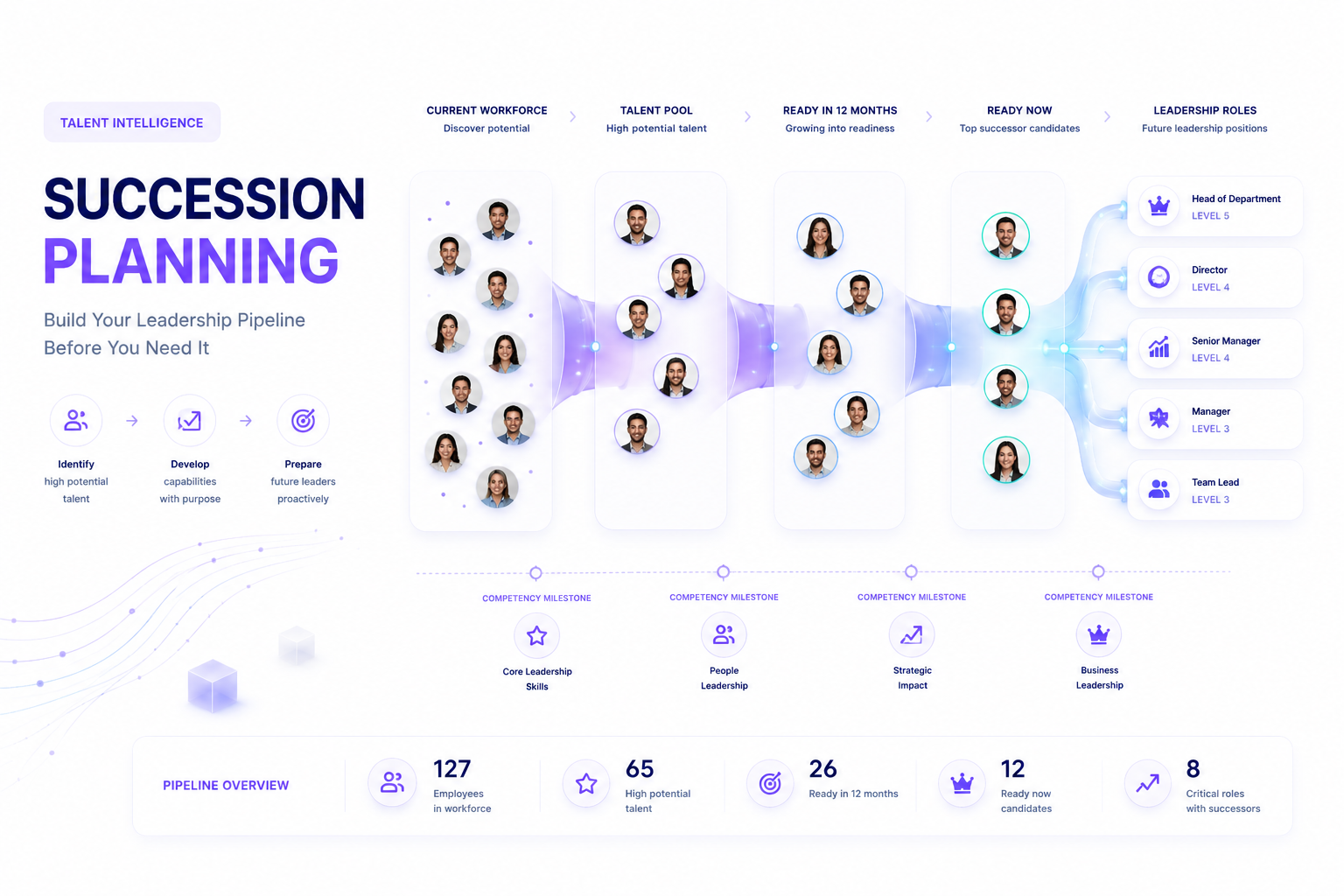
Succession Planning is the process of identifying and developing employees who can step into critical roles in the future, reducing organizational risk and supporting sustainable growth.
- Succession Planning reduces dependency on key individuals.
- Effective succession strategies rely on competency data rather than intuition.
- Competency Frameworks, Skill Gap Analysis, and Career Paths form the foundation of succession planning.
What Is Succession Planning?
What would happen if your Head of Sales resigned next month?
Or if the person running a critical business function unexpectedly left the company?
Many organizations only start looking for a replacement after the problem occurs. By then, recruiting costs, onboarding time, and operational disruption can become significant.
This is why growing organizations invest in Succession Planning.
Succession Planning is the process of identifying and developing employees who can step into critical roles in the future, ensuring business continuity and supporting long-term growth.
Why Is Succession Planning Important?
Many companies assume succession planning is only relevant for large enterprises.
In reality, small and mid-sized businesses often face greater risk because they rely heavily on a handful of key individuals.
Common warning signs include:
- No clear replacement for critical roles
- Long hiring cycles when managers leave
- Lack of leadership pipeline
- Promotions based on intuition rather than readiness
- Difficulty scaling teams as the company grows
A critical role without a successor is an operational risk waiting to happen.
How Is Succession Planning Different From Recruiting?
| Recruiting | Succession Planning |
|---|---|
| Finds talent externally | Develops talent internally |
| Reacts to immediate needs | Prepares for future needs |
| Focuses on current vacancies | Focuses on future leadership requirements |
| Often requires lengthy hiring processes | Reduces replacement time and risk |
This does not mean organizations should stop hiring externally.
The goal is to identify positions where internal development can be prioritized before external recruitment becomes necessary.
Who Should Be Included In Succession Planning?
Not every employee needs to be part of a formal succession plan.
Organizations typically focus on:
- Team Leads
- Functional Managers
- Department Heads
- Employees with rare expertise
- High-potential future leaders
To identify the right candidates, companies first need a standardized understanding of workforce capabilities through a Competency Framework.
The Foundation Of Effective Succession Planning
Competency Framework
A strong succession strategy starts with defining the competencies required for each role.
Without a clear framework, it becomes difficult to determine who is truly ready for future leadership positions.
Skill Gap Analysis
Once role requirements are defined, organizations need to understand the gap between current capability and future expectations.
This is where Skill Gap Analysis becomes essential.
For example:
| Competency | Team Lead Requirement | Current Employee |
|---|---|---|
| Coaching | Level 3 | Level 2 |
| Strategic Thinking | Level 3 | Level 1 |
These gaps become the basis for individual development plans.
Career Path
Succession Planning should not exist in isolation.
It works best when connected to a structured Career Path that helps employees understand:
- Their next potential role
- The competencies required to get there
- Their current level of readiness
Succession Planning And Internal Mobility
Many organizations think about succession only in terms of upward promotion.
However, modern companies also use Internal Mobility to strengthen their leadership pipeline.
Examples include:
- Product Manager → Product Lead
- Customer Success Manager → Operations Manager
- Senior Sales Representative → Team Lead
This approach helps organizations maximize existing talent before looking externally.
Common Mistakes In Succession Planning
Promoting Based Only On Performance
Strong individual contributors do not automatically become effective leaders.
Relying On Subjective Judgments
Selecting successors based on personal opinions often creates bias and poor outcomes.
Treating Succession Planning As A One-Time Project
Business priorities and employee capabilities change over time.
Succession plans should be reviewed and updated regularly.
From Succession Planning To Talent Intelligence
Succession Planning is no longer just an HR process.
It is a critical component of Talent Intelligence that helps organizations answer strategic questions such as:
- Who is ready for the next role?
- Which positions face succession risk?
- What competencies are missing across the workforce?
- Where should we invest in internal development versus external hiring?
At this stage, workforce capability data becomes strategic business intelligence.
See How SkillMAP Supports Succession Planning
SkillMAP helps organizations:
- Build competency frameworks
- Assess workforce capabilities
- Identify skill gaps
- Measure workforce readiness
- Develop leadership pipelines
- Support Talent Intelligence with actionable data
👉 Explore SkillMAP Demo with sample data
👉 Or talk with our team about Succession Planning strategy for your organization
Frequently Asked Questions
What is Succession Planning?
Succession Planning is the process of identifying and preparing employees to take over key positions in the future.
Do small and mid-sized businesses need Succession Planning?
Yes. Growing companies are often more vulnerable because critical knowledge and leadership responsibilities are concentrated in a small number of people.