Quick Takeaways
Performance Reviews evaluate past results, while Talent Reviews assess future potential, readiness, and organizational capability. Both are essential but serve different purposes.
- Performance Review measures past performance.
- Talent Review supports future talent decisions.
- Talent Review considers potential, readiness, and business needs.
- The strongest organizations use both together.
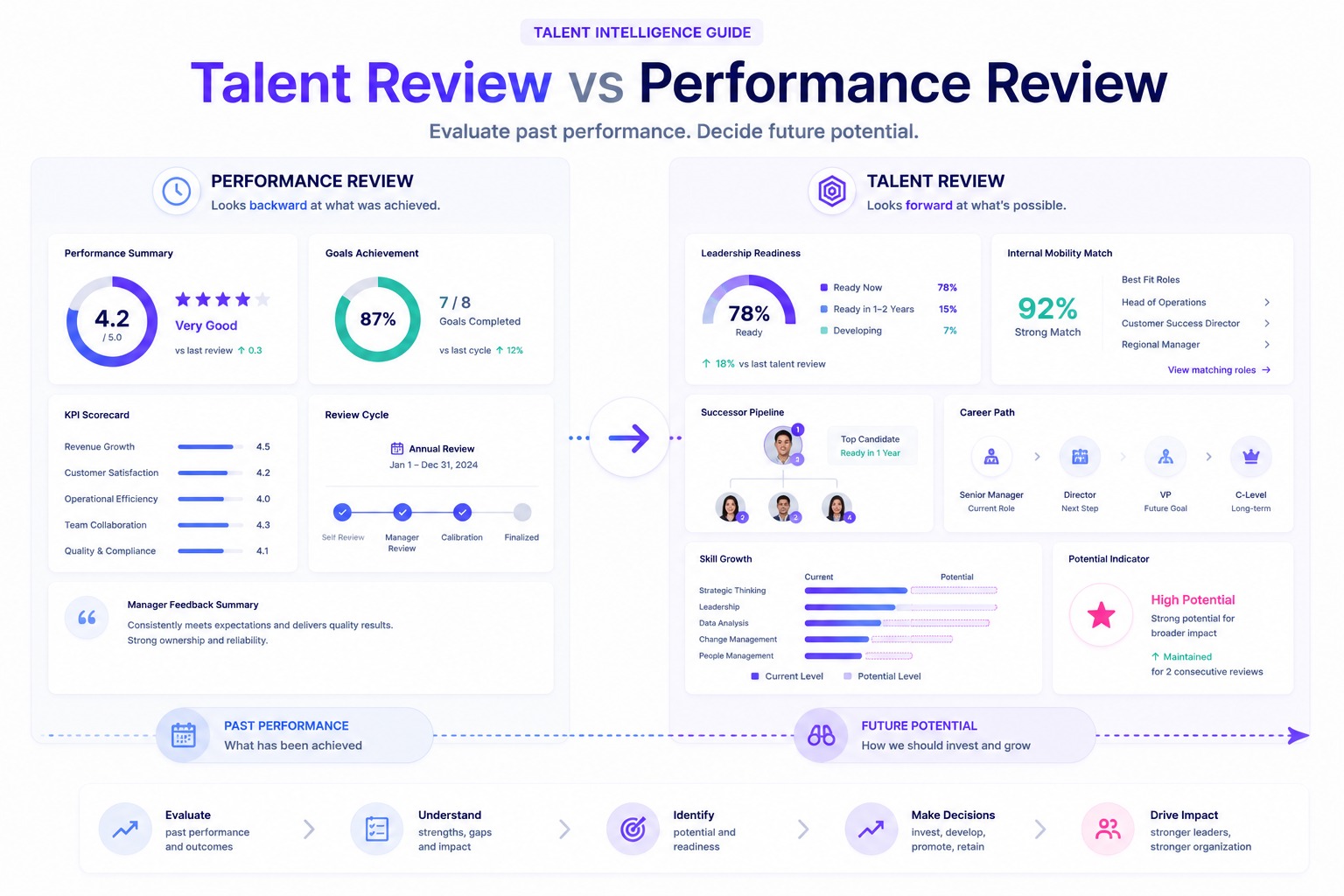
Talent Review vs Performance Review: What’s the Difference?
Many organizations use the terms Talent Review and Performance Review interchangeably.
They shouldn’t.
Although both involve evaluating employees, they answer fundamentally different questions.
A Performance Review asks:
How well did this employee perform in the past?
A Talent Review asks:
What should we do with this employee next?
That distinction changes how organizations develop leaders, identify successors, and build future-ready teams.
What Is a Performance Review?
A Performance Review evaluates an employee’s past performance over a defined period.
It typically focuses on:
- Goals and KPIs
- Business results
- Behavioral expectations
- Manager feedback
- Areas for improvement
Its primary purpose is accountability and performance management.
Performance Reviews often influence:
- Compensation
- Bonuses
- Promotions
- Individual development plans
In short, they measure what has already happened.
What Is a Talent Review?
A Talent Review is a strategic discussion about an organization’s people.
Instead of evaluating completed work, it evaluates future potential and organizational needs.
Questions often include:
- Who is ready for promotion?
- Who has leadership potential?
- Which critical roles lack successors?
- Who could move across functions?
- Which capabilities are missing across the organization?
Talent Reviews help leaders make forward-looking talent decisions.
Talent Review vs Performance Review
| Category | Performance Review | Talent Review |
|---|---|---|
| Primary focus | Past performance | Future potential |
| Time horizon | Backward-looking | Forward-looking |
| Main objective | Evaluate results | Make talent decisions |
| Participants | Employee + Manager | HR + Business Leaders |
| Frequency | Annual or quarterly | Periodic strategic reviews |
| Business outcome | Feedback and appraisal | Promotions, succession, mobility |
Rather than replacing each other, they complement each other.
Performance Doesn’t Always Predict Potential
One of the biggest misconceptions in talent management is assuming that the highest performers automatically become the best future leaders.
That isn’t always true.
An employee may consistently exceed targets because they are an outstanding individual contributor.
Leading a team, however, requires a different set of capabilities:
- Coaching
- Decision-making
- Communication
- Strategic thinking
- Change leadership
Talent Reviews help organizations distinguish between high performance and high potential.
Why Growing Companies Need Talent Reviews
As organizations scale, talent decisions become more complex.
Leadership teams need visibility into questions such as:
- Which teams have strong leadership pipelines?
- Where are the biggest succession risks?
- Which employees are ready for broader responsibilities?
- Which critical skills are concentrated in only a few people?
- Where should internal mobility be encouraged?
These decisions cannot be made from performance ratings alone. They require a broader understanding of workforce capability.
Talent Review Is a Business Conversation
Performance Reviews are usually conducted between a manager and an employee.
Talent Reviews involve a wider group.
Typical participants include:
- HR Director
- Business Leaders
- Department Heads
- Executive Team
Rather than discussing one individual at a time, they discuss organizational capability as a whole.
The conversation shifts from:
“How did Sarah perform?”
to
“Is Sarah ready to lead the new regional team?”
How Talent Intelligence Improves Talent Reviews
Traditional Talent Reviews often rely on spreadsheets and manager opinions.
Talent Intelligence Platforms make these discussions more objective by providing visibility into:
- Skills
- Competencies
- Readiness
- Career aspirations
- Internal mobility opportunities
- Succession pipelines
Instead of relying on memory or assumptions, leaders can make decisions using consistent workforce data.
When Should Companies Use Both?
The strongest organizations don’t choose between Performance Reviews and Talent Reviews.
They use each for a different purpose.
A common sequence looks like this:
- Conduct Performance Reviews.
- Update employee skills and competencies.
- Hold Talent Review sessions.
- Identify successors and internal mobility opportunities.
- Create development plans based on organizational priorities.
Performance data becomes one input into a broader talent decision-making process.
Conclusion
Performance Reviews measure what employees have achieved.
Talent Reviews determine what the organization should do next.
One looks backward. The other prepares the business for the future.
Growing organizations need both—not because they serve the same purpose, but because together they create a more complete picture of workforce capability.
Related Articles
- What Is Internal Mobility?
- What Is Succession Planning?
- What Is Talent Intelligence?
- HRIS vs Talent Intelligence Platform
Frequently Asked Questions
What is the difference between Talent Review and Performance Review?
Performance Reviews evaluate past results, while Talent Reviews assess future potential, readiness, and organizational talent needs.
Can Talent Reviews replace Performance Reviews?
No. Performance Reviews provide valuable input, while Talent Reviews use that information alongside skills, potential, and business priorities to make talent decisions.
Who participates in a Talent Review?
Talent Reviews typically involve HR leaders, department heads, and executives who make workforce planning and succession decisions.
How often should Talent Reviews be conducted?
Many organizations conduct Talent Reviews annually or semi-annually, often after completing Performance Reviews.