Quick Takeaways
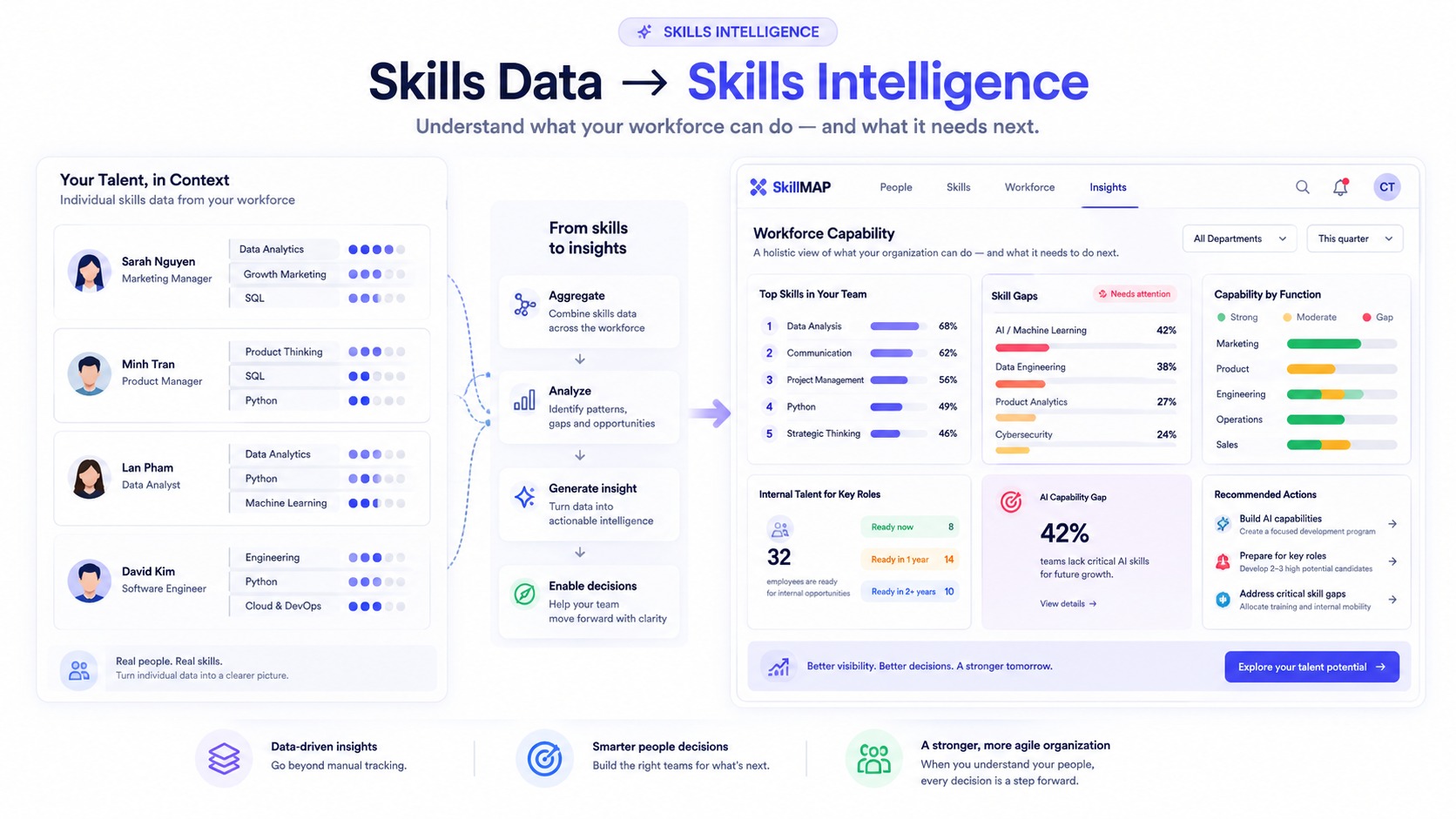
Skills Intelligence is the ability to collect, structure, analyze, and use workforce skills data to understand organizational capability, identify gaps, and make better talent and workforce decisions.
- Skills Intelligence turns fragmented employee skills data into actionable workforce insight.
- It goes beyond maintaining a skills inventory by connecting skills data to business and talent decisions.
- Skills Intelligence can support skill gap analysis, internal mobility, workforce planning, and succession.
- Reliable skills data is the foundation of effective Talent Intelligence.
What Is Skills Intelligence?
Most companies have employee data.
Far fewer have a clear picture of their workforce capability.
An organization might know:
- How many employees it has
- Which teams they belong to
- Their job titles
- Their years of experience
But that does not necessarily tell the organization:
What skills do we actually have?
Where are our biggest capability gaps?
Which skills are becoming more important?
Who already has the skills we need?
This is where Skills Intelligence comes in.
Skills Intelligence is the ability to collect, structure, analyze, and use workforce skills data to understand organizational capability and support better talent decisions.
In simple terms:
Skills data tells you what people can do. Skills Intelligence helps you understand what that means for the organization.
Skills Intelligence vs. Skills Management
The two concepts are closely related, but they serve different purposes.
| Skills Management | Skills Intelligence | |
|---|---|---|
| Primary focus | Manage and develop skills | Understand and analyze skills |
| Main question | ”How do we manage these skills?" | "What do these skills tell us?” |
| Data | Skills, proficiency, learning | Skills + roles + workforce + business context |
| Output | Skill development actions | Workforce insights and decisions |
| Typical use cases | Training, development, skill tracking | Mobility, workforce planning, gap analysis, talent strategy |
Skills Management is about managing capability.
Skills Intelligence is about understanding capability well enough to make decisions.
The two should work together.
Why Traditional Employee Data Is Not Enough
Consider two employees:
Employee A
- Product Manager
- 6 years of experience
- Level: Senior
Employee B
- Product Manager
- 5 years of experience
- Level: Senior
From an HRIS perspective, they may look almost identical.
But their actual capabilities could be very different.
Employee A might have:
- Product analytics
- Customer research
- Pricing strategy
- SQL
Employee B might have:
- Go-to-market strategy
- Stakeholder management
- B2B sales
- Product marketing
If the company is launching a data-driven product, Employee A may be the stronger fit.
The job title alone does not reveal that.
Skills Intelligence adds the capability layer.
How Does Skills Intelligence Work?
Skills Intelligence typically brings together several layers of workforce data.
1. Skills
What can employees do?
Examples:
- Data analysis
- Project management
- Leadership
- Customer research
- Financial modeling
- Python
- Sales negotiation
2. Proficiency
How strong is each skill?
For example:
Data Analysis

Beginner     ███░░
Intermediate ████░
Advanced     █████
3. Experience
Where and how has the employee applied the skill?
Someone may have a skill listed on their profile but limited practical experience.
4. Roles
Which skills are associated with each role?
This creates a connection between:
People → Skills → Roles
5. Business needs
Which skills will the organization need next?
This creates another connection:
Current Capability → Future Capability
When these layers come together, skills data becomes much more useful.
From Skills Inventory to Skills Intelligence
A Skills Inventory is an important starting point.
It answers:
What skills exist in the organization?
For example:
Data Analysis       42 employees
Project Management  37 employees
Python              18 employees
AI                  11 employees
But Skills Intelligence goes further.
It asks:
Where are those skills?
What level of proficiency do they have?
Which roles need them?
Where are the gaps?
Which employees could develop into future roles?
Which skills are becoming strategically important?
That is the difference between having data and using data intelligently.
You can learn more about building a Skills Inventory.
What Can Skills Intelligence Help Organizations Do?
1. Identify Skill Gaps
Organizations can compare current capability with the skills required for strategic priorities.
For example:
Current Workforce
       ↓
Available Skills
       ↓
Required Skills
       ↓
Skill Gap
This makes skill gap analysis more actionable.
See Skill Gap Analysis.
2. Improve Internal Mobility
Skills Intelligence can help answer:
Who inside the organization could be a fit for this opportunity?
Instead of searching only by job title, organizations can search by capability.
This creates the foundation for an Internal Talent Marketplace.
The flow becomes:
Skills Intelligence
        ↓
Workforce Visibility
        ↓
Talent → Opportunity Matching
        ↓
Internal Mobility
3. Support Workforce Planning
Workforce planning traditionally focuses heavily on headcount.
But headcount alone does not tell you whether the workforce can execute the strategy.
Skills Intelligence adds another layer:
Do we have the capabilities we need?
For example:
A company plans to expand into AI-enabled products.
Headcount planning may say:
We need 20 more people.
Skills Intelligence can ask:
Do we actually need 20 new hires?
Perhaps the organization already has:
- 8 people with relevant technical skills
- 5 people who can be reskilled
- 3 people ready for expanded responsibilities
Now the workforce strategy becomes more precise.
4. Support Succession Planning
Succession planning depends on understanding future capability.
Instead of asking only:
Who is next in line?
Organizations can ask:
Who has the skills required for this role?
Which skills are missing?
Who could close those gaps?
This makes succession planning more evidence-based.
5. Understand Workforce Readiness
A strategy is only as executable as the workforce behind it.
Skills Intelligence can help connect:
Business Strategy
↓
Required Capabilities
↓
Current Workforce Skills
↓
Readiness Gaps
This is one reason Skills Intelligence is becoming increasingly relevant to workforce planning and Talent Intelligence.
Skills Intelligence Is Not Just a Skills Database
A database stores information.
Intelligence creates understanding.
A skills database might tell you:
25 employees have project management skills.
Skills Intelligence can help answer:
Where are those 25 employees?
What proficiency levels do they have?
Which teams depend on project management?
Where are we under-covered?
Which employees could take on larger projects?
What happens if we need 20% more project management capability next year?
That difference matters.
The goal is not to collect more employee data.
The goal is to make the data useful for decisions.
What Data Do You Need for Skills Intelligence?
There is no single perfect dataset.
But a useful foundation usually includes:
Workforce data
- Employee
- Role
- Team
- Level
- Experience
Skills data
- Skill
- Proficiency
- Evidence
- Relevant experience
Organizational data
- Roles
- Competencies
- Required skills
- Business priorities
Talent data
- Career interests
- Development goals
- Mobility interests
- Readiness
The more these datasets can be connected, the more useful the resulting intelligence becomes.
Skills Intelligence and Talent Intelligence
Skills Intelligence is closely connected to Talent Intelligence.
A useful way to think about the relationship is:
Workforce Data
      ↓
Skills Data
      ↓
Skills Intelligence
      ↓
Talent Intelligence
      ↓
Talent Decisions
Skills are one of the most important signals for understanding workforce capability.
But Talent Intelligence can incorporate a broader set of signals, including:
- Skills
- Experience
- Performance
- Potential
- Career interests
- Organizational needs
- Workforce trends
So Skills Intelligence can be viewed as an important capability layer within Talent Intelligence.
How to Build Skills Intelligence
Organizations do not need to start with a complex technology implementation.
A practical approach is:
Step 1: Define the skills that matter
Start with the skills relevant to your organization and critical roles.
Avoid trying to create a list of thousands of skills immediately.
Step 2: Build your workforce skills inventory
Understand what skills exist today.
Include proficiency and evidence where possible.
Step 3: Map skills to roles
Define which skills matter for different roles and levels.
Step 4: Identify gaps
Compare current capability with required capability.
Step 5: Connect skills to talent decisions
Use the data to support:
- Internal mobility
- Career development
- Succession
- Workforce planning
- Reskilling
- Talent reviews
This is where Skills Intelligence moves from a data project to a business capability.
The Future of Workforce Planning Is Skills-Based
Companies have historically planned their workforce around:
Headcount + Job Titles
A skills-based approach adds another layer:
Headcount + Roles + Skills + Capability
That shift changes the questions leaders can ask.
Instead of:
How many people do we have?
They can ask:
What can our workforce do?
Instead of:
How many people do we need?
They can ask:
What capabilities do we need next?
And instead of:
Who should we hire?
They can ask:
Do we already have the capability somewhere inside the organization?
That is the real value of Skills Intelligence.
Skills Intelligence and SkillMAP
SkillMAP helps organizations turn workforce skills data into a clearer view of organizational capability.
Instead of keeping skills information across spreadsheets, assessments, and disconnected HR systems, SkillMAP brings together data around:
- Workforce skills
- Skill gaps
- Role capability
- Career readiness
- Internal talent
- Workforce insights
The goal is not simply to build another skills database.
It is to help HR and business leaders answer:
What can our workforce do today — and are we ready for what comes next?
👉 Explore SkillMAP Demo with sample data
👉 Or talk with our team about Skills Intelligence
FAQs
What is Skills Intelligence?
Skills Intelligence is the ability to collect, analyze, and use workforce skills data to understand organizational capability, identify gaps, and support talent and workforce decisions.
How is Skills Intelligence different from Skills Management?
Skills Management focuses on managing and developing employee skills. Skills Intelligence focuses on analyzing skills data to generate insights that support broader organizational decisions.
Is Skills Intelligence the same as a Skills Inventory?
No. A Skills Inventory records the skills available in a workforce. Skills Intelligence uses that data together with roles, proficiency, experience, and business needs to generate actionable insights.
Why is Skills Intelligence important?
It helps organizations understand their existing capabilities, identify skill gaps, improve internal mobility, support workforce planning, and make more informed talent decisions.
How does Skills Intelligence support Talent Intelligence?
Skills are a core source of workforce capability data. Skills Intelligence helps turn that data into insights that can feed broader Talent Intelligence and talent decision-making.
Frequently Asked Questions
What is Skills Intelligence?
Skills Intelligence is the ability to understand, analyze, and use workforce skills data to identify organizational capability, gaps, and opportunities.
How is Skills Intelligence different from Skills Management?
Skills Management focuses on maintaining and developing workforce skills, while Skills Intelligence focuses on turning skills data into insights that support business and talent decisions.
Why is Skills Intelligence important?
It helps organizations understand what capabilities they already have, where skill gaps exist, and how workforce capability aligns with business needs.
Is Skills Intelligence the same as a Skills Inventory?
No. A Skills Inventory is a structured record of workforce skills. Skills Intelligence builds on that data to generate insights and support decisions.