Quick Takeaways
A Skills Gap Analysis Template helps organizations compare current workforce capabilities with future business needs. The real value comes from continuously updating and acting on that data.
- Templates are a starting point, not the solution.
- Skills gaps should be monitored continuously.
- Talent Intelligence replaces manual spreadsheet updates with real-time workforce insight.
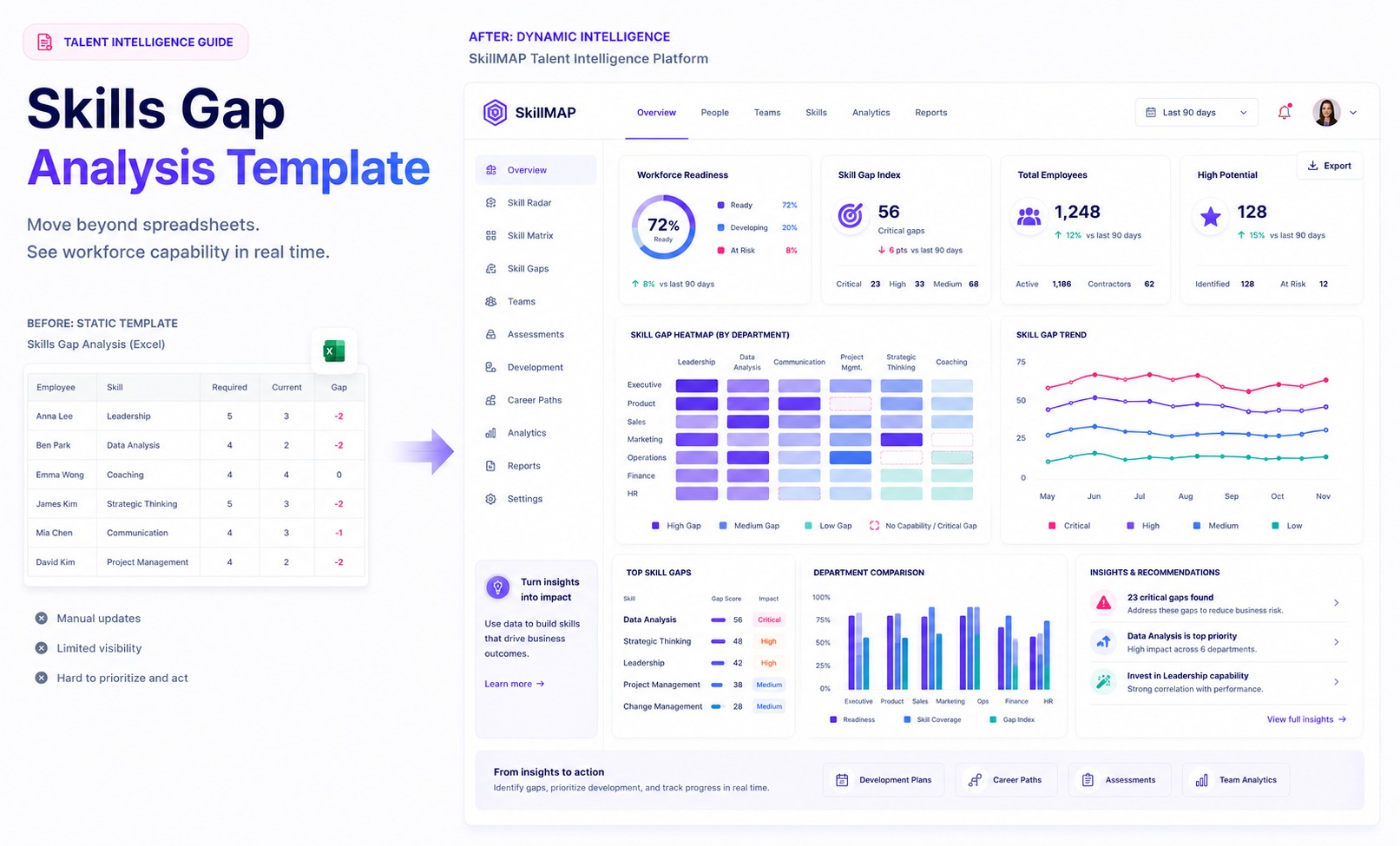
Most companies don’t have a training problem.
They have a visibility problem.
Every year, organizations invest heavily in learning and development.
Employees attend workshops.
Complete certifications.
Join leadership programs.
Finish online courses.
Yet when leadership reviews workforce capability six months later, very little seems to have changed.
Why?
Because training was never the problem.
The organization simply didn’t know which skills mattered most—or who actually needed them.
Without that understanding, learning becomes activity instead of strategy.
This is exactly where a Skills Gap Analysis Template becomes valuable.
Not because it’s another spreadsheet.
But because it gives organizations a structured way to answer one of the most important workforce questions:
What capabilities do we have today, and what capabilities will we need tomorrow?
That’s the foundation of every effective talent strategy.
What is a Skills Gap Analysis Template?
A Skills Gap Analysis Template is a framework that compares:
- Current employee skills.
- Required skills for a role.
- The gap between the two.
- Recommended development priorities.
A simple template usually includes fields like:
| Employee | Role | Skill | Required Level | Current Level | Gap | Priority |
|---|
On the surface, it looks like a basic spreadsheet.
In reality, it helps answer much larger business questions.
- Which teams lack critical capabilities?
- Which skills are becoming business risks?
- Where should training budgets be invested?
- Who is ready for more responsibility?
- Which capability gaps threaten future growth?
That’s why Skills Gap Analysis supports far more than learning and development.
It also influences Workforce Planning, Internal Mobility, Succession Planning, Career Development, and Talent Acquisition.
A template won’t solve the real problem
Many organizations believe finding the right template is the hardest part.
It isn’t.
A template accounts for perhaps 20% of successful Skills Gap Analysis.
The remaining 80% depends on data quality.
Consider these situations.
Different managers define competency levels differently.
Job requirements haven’t been updated in years.
Employee skills are only reviewed once annually.
Training records aren’t connected to assessment results.
Even the most beautifully designed spreadsheet cannot produce meaningful insight from inconsistent data.
The principle is simple:
Garbage in. Garbage out.
Templates don’t create visibility.
Reliable workforce data does.
A simple Skills Gap Analysis Template
For organizations getting started, a straightforward structure is often enough.
| Skill | Required Level | Current Level | Gap | Action |
|---|---|---|---|---|
| Data Analysis | 4 | 2 | -2 | Training |
| Coaching | 4 | 3 | -1 | Mentoring |
| Presentation | 3 | 3 | 0 | Monitor |
| Leadership | 5 | 2 | -3 | High Priority Development |
The real value comes from how the information is used.
If the spreadsheet simply gets archived after each review cycle, nothing changes.
But when those insights drive learning plans, workforce planning, succession decisions, and internal mobility, the template becomes the starting point of a much larger workforce strategy.
When spreadsheets stop being enough
Spreadsheets are an excellent place to start.
In fact, for smaller organizations building their first competency framework, Excel is often the right choice.
The problem isn’t Excel.
The problem is scale.
1. HR spends more time maintaining data than analyzing it
After every assessment cycle, HR teams often need to merge multiple spreadsheets, validate inconsistent entries, resolve version conflicts, and rebuild reports.
Eventually, most of the effort goes into managing data instead of generating insights.
When administration consumes more time than decision-making, the process has stopped creating value.
2. Skills data is only updated once or twice a year
Skills evolve continuously.
Employees complete projects, earn certifications, take on new responsibilities, learn new technologies, and move into different roles.
Yet many organizations refresh their skills database only during annual performance reviews.
That means every workforce decision made between review cycles is based on outdated information.
Modern workforce planning requires continuous visibility—not annual snapshots.
3. Leadership can’t see the organization’s capability picture
A spreadsheet can answer:
“Does Emma meet the competency requirement for her role?”
But executives ask questions such as:
- Which departments have the largest capability gaps?
- Where will future skills shortages occur?
- Which leadership pipelines are strongest?
Those are organizational questions. Spreadsheets struggle to answer them.
Skills Gap Analysis is about much more than training
One of the biggest misconceptions is that Skills Gap Analysis exists solely to support Learning & Development.
Training is only one application.
Workforce Planning
The most important expansion question isn’t “How many people should we hire?” It’s “Do we already have the capabilities needed to support that expansion?”
Skills Gap Analysis provides the data required to answer that question.
Internal Mobility
Organizations frequently recruit externally while overlooking qualified internal talent.
Skills Gap Analysis helps organizations understand who could transition into new roles, what additional capabilities they need, and how long development might take.
Succession Planning
Leadership readiness is rarely binary.
An employee may not be ready today—but could become ready within six months.
Continuous Skills Gap Analysis helps organizations monitor that progress and prepare for leadership vacancies before they occur.
From Templates to Talent Intelligence
Templates are useful.
But every template has the same limitation.
It represents a single moment in time.
Workforce capability doesn’t.
Skills evolve every week. Business priorities shift. New technologies emerge.
The workforce is constantly moving.
Keeping all of that information current inside spreadsheets eventually becomes impossible.
This is why many organizations move beyond templates toward Talent Intelligence Platforms.
Rather than updating spreadsheets manually, these platforms continuously connect workforce data across the organization.
As a result, skills profiles stay current, capability gaps update automatically, and leaders gain immediate visibility into talent risks and opportunities.
At that point, organizations are no longer managing spreadsheets.
They’re managing workforce intelligence.
How to Build an Effective Skills Gap Analysis
Step 1. Define the capabilities your business needs
Every Skills Gap Analysis should begin with strategic objectives — expanding into a new market, launching AI initiatives, building stronger leadership pipelines.
Without a clear business context, organizations often assess skills that have little impact on future performance.
Step 2. Assess current workforce capabilities
Collect data from multiple sources: Competency Assessments, self-assessments, manager evaluations, 360-degree feedback, performance outcomes, learning records, and certifications.
Step 3. Identify the gaps that matter most
Prioritize skills that directly support business strategy, affect multiple teams, are difficult to recruit externally, and represent significant business risk if left unresolved.
Step 4. Turn insights into action
| Skills Gap | Recommended Action |
|---|---|
| Technical knowledge | Formal learning or certification |
| Practical experience | Stretch assignments |
| Leadership capability | Coaching and mentoring |
| Cross-functional understanding | Job rotation |
| Succession readiness | Leadership development plans |
Training is only one option. Sometimes the fastest way to build capability is through experience, mentoring, or internal mobility.
Step 5. Monitor continuously
Workforce capability changes constantly.
Employees learn. Projects create new experience. Roles evolve. Business priorities shift.
If capability data isn’t updated continuously, decisions become increasingly disconnected from reality.
Skills Gap Analysis shouldn’t be viewed as an annual HR activity.
It should become an ongoing business capability.
Conclusion
A Skills Gap Analysis Template is an excellent starting point for understanding workforce capability.
It helps organizations identify critical skill gaps, prioritize development investments, and align talent initiatives with business goals.
But the template itself is never the competitive advantage.
The advantage comes from maintaining accurate workforce data and using it to make better decisions every day.
As organizations grow, many move beyond spreadsheets toward platforms that continuously connect competency, skills, workforce planning, and talent development.
That transition represents something much bigger than adopting new software.
It represents a shift:
From documenting workforce capability to understanding workforce capability.
That’s the essence of Talent Intelligence.
Related Articles
- What Is Skill Gap Analysis?
- What Is Skills Inventory?
- What Is Competency Management?
- What Is Workforce Planning?
- What Is Workforce Analytics?
- What Is Talent Intelligence?
See SkillMAP in Action
👉 Explore SkillMAP Demo with sample data
See how SkillMAP automatically connects competency data, workforce skills, and organizational capability to identify skills gaps in real time.
👉 Or talk with our team about Skills Gap Analysis
FAQs
What is a Skills Gap Analysis Template?
A Skills Gap Analysis Template is a framework used to compare current employee capabilities with the skills required for a role or business objective. It helps organizations identify capability gaps, prioritize development, and support workforce planning.
Should I use Excel for Skills Gap Analysis?
Excel is an excellent starting point for smaller organizations. As workforce complexity grows, maintaining accurate data and generating meaningful insights becomes increasingly difficult, making dedicated software a better long-term option.
How often should Skills Gap Analysis be updated?
Organizations should update skills data continuously whenever employees develop new capabilities, change roles, complete learning programs, or business priorities shift. Annual reviews alone rarely provide an accurate picture of workforce readiness.
What’s the difference between Skills Gap Analysis and Competency Assessment?
Competency Assessment measures current employee capabilities against defined competencies. Skills Gap Analysis uses that information to identify the difference between current capability and future business requirements.
When should organizations move beyond spreadsheets?
When skills data becomes fragmented, reporting requires significant manual effort, or leadership needs real-time workforce insights to support hiring, development, succession planning, and workforce planning.
Frequently Asked Questions
What is a Skills Gap Analysis Template?
A framework that compares current employee skills with required skills to identify capability gaps and development priorities.
Should you use Excel for Skills Gap Analysis?
Excel works well for smaller organizations but becomes difficult to maintain as workforce complexity grows.
When should companies adopt dedicated software?
When data becomes fragmented, reporting requires significant manual effort, or leadership needs real-time workforce insights.