Quick Takeaways
An Internal Talent Marketplace connects employees with internal opportunities such as jobs, projects, mentoring, and development programs based on their skills, experience, and career interests.
- An Internal Talent Marketplace helps companies discover and deploy existing talent before looking outside the organization.
- Unlike an internal job board, a Talent Marketplace can use skills and workforce data to create better talent-opportunity matches.
- Skills visibility is a foundation for effective internal talent marketplaces.
- Internal mobility goes beyond job transfers to include projects, stretch assignments, mentoring, and development opportunities.
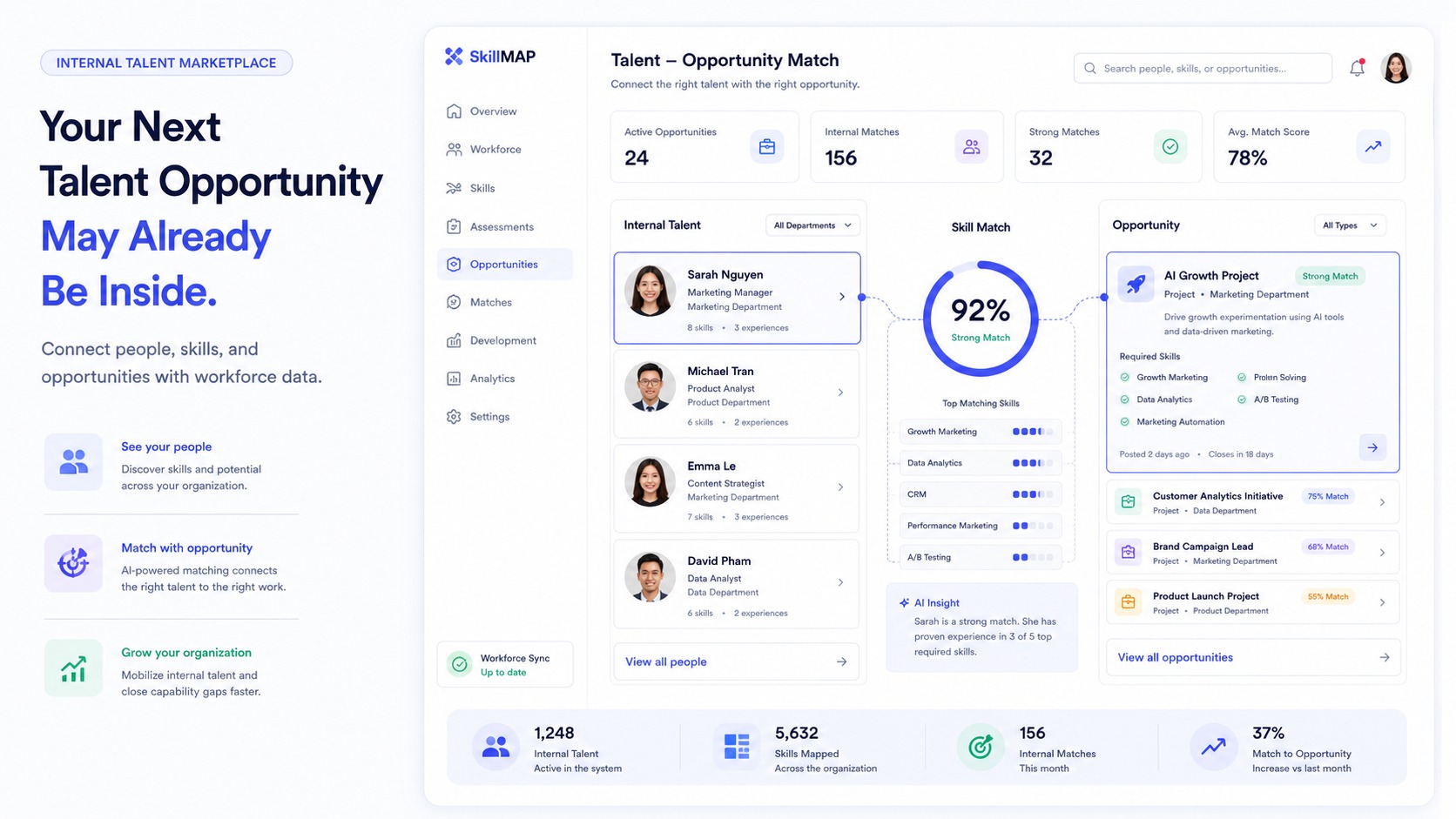
What Is an Internal Talent Marketplace?
When a new position opens, the typical response is:
Write a job description → post the role → search for external candidates.
But there is another question companies should ask first:
Does someone inside the organization already have the skills needed for this role?
That is the problem an Internal Talent Marketplace is designed to address.
An Internal Talent Marketplace is a platform that connects existing employees with internal opportunities — from open roles and projects to stretch assignments, mentoring, and development opportunities — based on skills, experience, and career interests.
Put simply:
External hiring looks for talent outside the organization. An Internal Talent Marketplace helps companies see the talent they already have.
This becomes increasingly important as organizations move from managing people primarily by job title toward a skills-based approach to workforce management.
How Does an Internal Talent Marketplace Work?
An Internal Talent Marketplace connects two sides of the organization.
The employee side
Employees can build profiles that include:
- Current role
- Skills
- Skill proficiency
- Experience
- Career interests
- Development goals
- Certifications
- Project experience
The organization side
Companies can make different types of opportunities available, including:
- Internal job openings
- Short-term projects
- Cross-functional assignments
- Stretch assignments
- Mentoring
- Development programs
The platform can then use workforce data to identify potential matches.
For example, imagine a company needs someone to contribute to an AI implementation project.
Instead of immediately creating a new position, the organization could identify:
8 existing employees with relevant skills.
Among them:
- 2 have strong technical skills
- 3 have relevant domain knowledge
- 3 could develop the remaining skills with targeted development
The question changes from:
“Who currently has this job?”
to:
“Who has the capability to do this work?”
That is an important shift enabled by Talent Intelligence.
Internal Talent Marketplace vs. Internal Mobility Software
The two terms are often used interchangeably.
They are related, but they are not exactly the same.
| Internal Mobility Software | Internal Talent Marketplace | |
|---|---|---|
| Primary goal | Help employees move into different roles | Connect talent with multiple types of opportunities |
| Focus | Jobs and career movement | Jobs, projects, and development |
| Data | Employee profiles and roles | Skills, experience, interests, and opportunities |
| Scope | Usually focused on mobility | Broader than mobility |
| Core question | ”Who could move into this role?" | "Which talent is a fit for this opportunity?” |
An Internal Talent Marketplace is therefore a broader concept.
Internal mobility remains an important part of it, but the marketplace expands the concept from:
Employee → New Job
to:
Talent → Opportunity
Why Do Companies Need an Internal Talent Marketplace?
1. Companies often cannot see all the skills they already have
An HRIS can tell you:
- Who works here
- What their job title is
- Which team they belong to
- How long they have been with the company
But it may not answer:
Who has skill X?
Who has worked on project Y?
Who could grow into role Z?
That is the gap between employee data and talent intelligence.
Without skills visibility, internal mobility is difficult to scale.
2. Job titles do not fully describe capability
Two employees can have the same title:
Marketing Manager
without having the same capabilities.
One might be strong in:
- Growth
- Performance Marketing
- Data Analytics
while another is stronger in:
- Brand
- Content
- Communications
If a company relies primarily on job titles to identify talent, it can miss significant internal capability.
An Internal Talent Marketplace looks deeper:
Skills + Experience + Interests + Opportunity
3. Internal mobility does not have to start with a new job
One common misconception is:
Internal mobility = moving into another job.
In reality, talent can develop through many types of opportunities:
Current Role
     ↓
Project
     ↓
Stretch Assignment
     ↓
Mentoring
     ↓
Cross-functional Experience
     ↓
New Role
A marketplace creates more opportunities for talent to connect with the organization.
What Data Does an Internal Talent Marketplace Need?
This is often underestimated.
A marketplace is only as useful as the data behind it.
Employee data
For example:
- Current role
- Skills
- Skill proficiency
- Experience
- Certifications
- Career interests
- Development goals
Opportunity data
For example:
- Required skills
- Required proficiency
- Role requirements
- Project duration
- Team
- Location
- Career level
The system can then identify:
Skill fit
between talent and opportunity.
This is why an Internal Talent Marketplace should not be treated simply as an internal job board.
A job board tells employees:
What jobs are open?
A Talent Marketplace should help answer:
Who is a good fit for this opportunity?
Internal Talent Marketplace and Talent Intelligence
An Internal Talent Marketplace is one of the practical applications of Talent Intelligence.
Talent Intelligence helps organizations understand:
What capabilities exist across the workforce?
The marketplace uses those insights to answer:
Where can those capabilities create value?
The relationship can be illustrated as:
Skills Data
     ↓
Talent Intelligence
     ↓
Workforce Capability Visibility
     ↓
Talent → Opportunity Matching
     ↓
Internal Mobility
     ↓
Better Workforce Decisions
So if a company wants to implement an Internal Talent Marketplace but does not have reliable skills data, the problem may not actually be the marketplace.
The problem may be visibility.
Internal Talent Marketplaces Are Not Just for Large Enterprises
Some SMEs may think:
“We only have 100–200 employees. Why would we need a marketplace?”
But smaller organizations can still have significant hidden capability.
For example, a 150-person company might have:
- 5 people with data analysis skills
- 3 people with project management experience
- 7 people with enterprise customer experience
- 4 people with leadership potential
- 10 people interested in a different career path
If this information only exists in CVs, manager memory, or spreadsheets, it is difficult to use systematically.
Skills-based workforce data can make those capabilities visible.
How to Get Started
Companies do not necessarily need to buy an Internal Talent Marketplace immediately.
Start with the underlying data.
Step 1: Build a Skills Inventory
Understand what skills already exist across the organization.
Learn more about Skills Inventory.
Step 2: Identify Skill Gaps
Compare current workforce capability with the capability the organization needs.
See Skill Gap Analysis.
Step 3: Map Skills to Roles
Identify:
- Which roles require which skills?
- What level of proficiency is needed?
- Which skills can be developed?
Step 4: Create Visibility into Opportunities
Do not limit opportunities to open jobs.
Include:
- Projects
- Development opportunities
- Mentoring
- Cross-functional assignments
- Internal roles
Step 5: Start Matching
Once workforce data is sufficiently reliable, organizations can start connecting:
People → Skills → Opportunities
That is the foundation of an Internal Talent Marketplace.
Does an Internal Talent Marketplace Replace Recruiting?
No.
And that should not be the goal.
An Internal Talent Marketplace does not mean:
“Never hire externally.”
It helps organizations ask a better question:
“Before hiring externally, have we fully explored the talent we already have?”
External hiring remains important when:
- The required skills do not exist internally
- Headcount needs to grow quickly
- The company enters a new market
- Completely new expertise is required
But with better workforce visibility, organizations gain another option:
Build or move talent internally before buying talent externally.
Internal Talent Marketplace Is the Next Step in Internal Mobility
Internal mobility has traditionally been viewed quite simply:
Employee moves from Role A → Role B.
Talent Intelligence expands that perspective.
Organizations can start by asking:
Who is here?
Then:
What can they do?
Then:
What could they do next?
And finally:
Where does the organization need those skills?
That is where an Internal Talent Marketplace becomes valuable.
Not because companies need another job board.
But because they need a better way to connect workforce capability with business opportunity.
Internal Talent Marketplace and SkillMAP
SkillMAP approaches this problem from the workforce capability layer.
Rather than starting with a list of open positions, SkillMAP helps organizations build visibility into:
- Workforce skills
- Skill gaps
- Career readiness
- Internal talent
- Workforce capability
This gives HR and managers a stronger data foundation for decisions around development, internal mobility, and workforce planning.
👉 Explore SkillMAP Demo with sample data
👉 Or talk with our team about Internal Talent Marketplace
FAQs
What is an Internal Talent Marketplace?
An Internal Talent Marketplace is a platform that connects employees with internal opportunities based on their skills, experience, career interests, and organizational needs.
How is an Internal Talent Marketplace different from Internal Mobility Software?
Internal Mobility Software typically focuses on helping employees move into different roles. An Internal Talent Marketplace has a broader scope, connecting talent with jobs, projects, mentoring, and development opportunities.
What does a company need before implementing an Internal Talent Marketplace?
Companies need reliable data about employee skills, experience, roles, and career interests, as well as a clear understanding of the skills required for each opportunity.
Does an Internal Talent Marketplace replace an HRIS?
No. An HRIS primarily manages employee records and operational HR data. A Talent Marketplace uses workforce and skills data to support talent matching and internal mobility decisions.
Is an Internal Talent Marketplace suitable for SMEs?
Yes. SMEs can also have significant hidden capability across their workforce. A skills-based approach can help them identify and use internal talent before looking externally.
Frequently Asked Questions
What is an Internal Talent Marketplace?
An Internal Talent Marketplace is a platform that connects employees with internal opportunities based on their skills, experience, career interests, and organizational needs.
How is an Internal Talent Marketplace different from Internal Mobility Software?
Internal Mobility Software typically focuses on helping employees move between roles. An Internal Talent Marketplace has a broader scope, connecting talent with jobs, projects, mentoring, and development opportunities.
What does a company need to implement an Internal Talent Marketplace?
A company needs reliable data about employee skills, experience, roles, and career interests, as well as a clear understanding of the skills required for each opportunity.
Does an Internal Talent Marketplace replace recruiting?
No. It helps companies prioritize internal talent when appropriate, while external hiring remains important when the organization lacks the required skills or capacity.