Quick Takeaways
Succession Planning Software helps organizations identify, assess, and develop future leaders. However, software only delivers value when supported by competency and workforce capability data.
- Succession planning is about readiness, not replacement.
- Competency Framework and Skill Matrix should come before software.
- Choose software that supports talent decisions, not just org charts.
- SMEs often need simplicity over enterprise complexity.
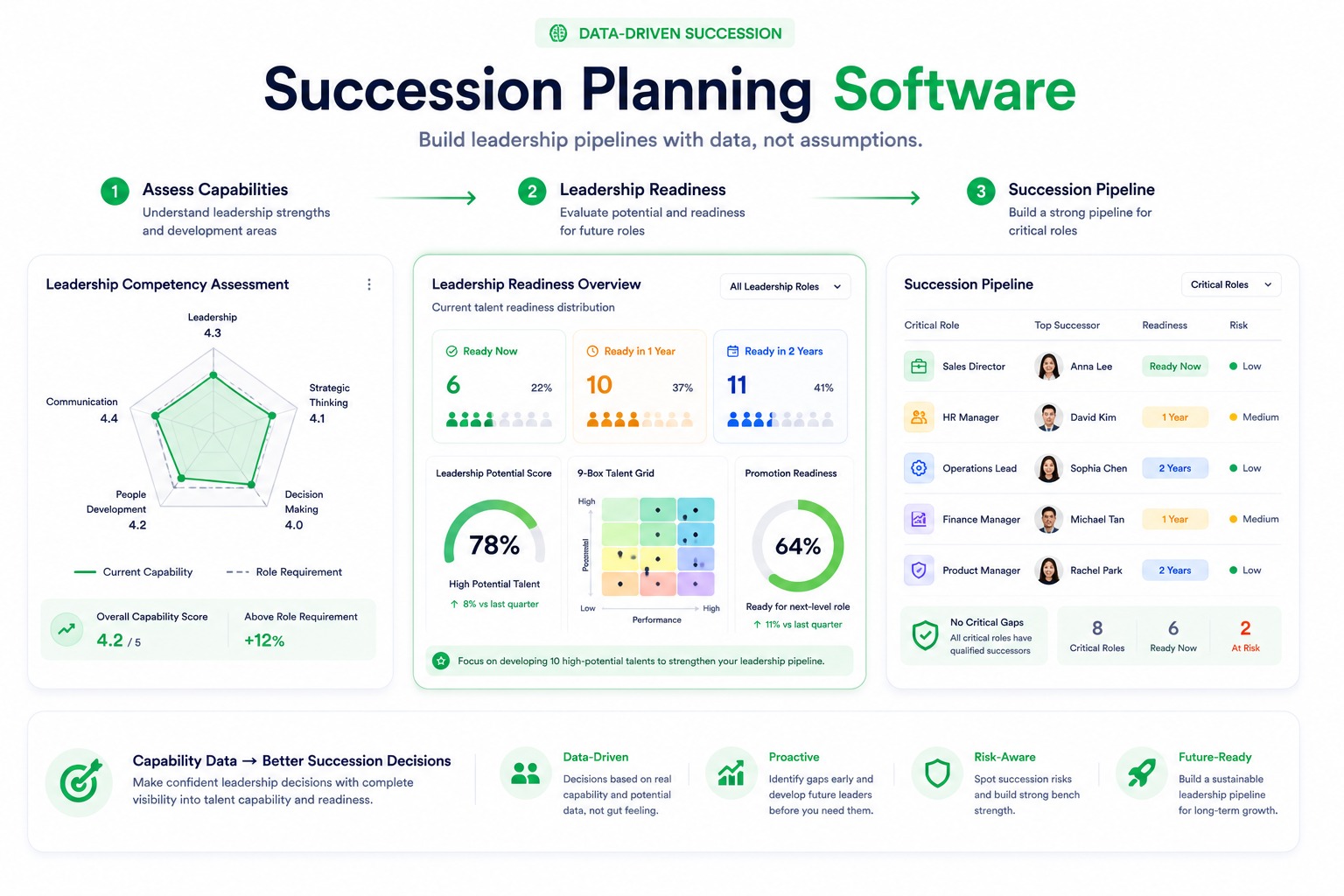
Succession Planning Software
Most organizations know succession planning is important.
Few have a reliable system to do it.
Leadership roles change.
Key employees resign.
Business priorities shift.
Yet many companies still manage succession planning using spreadsheets, PowerPoint slides, or annual discussions.
The result is predictable.
When a critical position becomes vacant, organizations scramble to find a replacement.
That’s why more HR teams are searching for Succession Planning Software.
But before choosing a platform, it’s important to understand what succession planning software should actually help you achieve.
What Is Succession Planning Software?
Succession Planning Software helps organizations identify, assess, and develop employees who are capable of filling critical roles in the future.
Rather than documenting names in an org chart, modern platforms help answer questions such as:
- Which positions have no successors?
- Who is ready today?
- Who could be ready within one or two years?
- Which competencies are missing?
- Where should development efforts be focused?
The objective is not simply replacing people.
It is ensuring business continuity.
Why Excel Isn’t Enough
Many SMEs begin succession planning in Excel.
Initially, this works.
But as the organization grows, maintaining accurate data becomes increasingly difficult.
Common challenges include:
- Employee skills change frequently.
- Readiness assessments become outdated.
- Managers use inconsistent evaluation criteria.
- Successor lists are updated only once a year.
The spreadsheet quickly becomes a static document rather than a decision-making tool.
Succession planning requires live workforce data.
What Features Should You Look For?
Good Succession Planning Software should do more than visualize an organizational chart.
Look for features such as:
- Competency Framework management
- Employee Skills Assessment
- Skill Matrix
- Readiness assessment
- Successor pipeline
- Development planning
- Internal Mobility insights
- Leadership dashboards
- Workforce analytics
These capabilities provide evidence—not assumptions—when selecting future leaders.
Start with Competency Data, Not Software
One of the biggest mistakes organizations make is buying succession planning software before defining what “ready” actually means.
If leadership competencies have never been defined, software cannot determine who is qualified.
The recommended sequence is:
- Build a Competency Framework.
- Assess employee competencies.
- Create a Skill Matrix.
- Identify leadership gaps.
- Develop employees.
- Support succession planning with software.
Software should strengthen the process—not replace it.
Enterprise Suite or Specialized Solution?
Large enterprise platforms often include succession planning alongside many other HR modules.
Examples include:
- Learning Management
- Recruitment
- Payroll
- Compensation
- Performance Management
These solutions are powerful but often require lengthy implementations and dedicated HR technology teams.
For organizations with 50–200 employees, a simpler platform focused on workforce capability may deliver faster value.
The goal is not to buy the biggest system.
The goal is to gain visibility into future leadership readiness.
Buyer’s Checklist
Before choosing a platform, ask these questions.
Do we already have a Competency Framework?
Without competency definitions, succession decisions become subjective.
Can we measure leadership readiness?
Future leaders should be assessed using consistent competency criteria—not manager opinions alone.
Can we identify skill gaps?
Software should show why someone is not yet ready and what development is required.
Does the platform support Internal Mobility?
Succession planning is closely connected to career development and internal mobility.
The right platform should support both.
Does it provide actionable insights?
The software should help leaders answer:
- Who is ready now?
- Who will be ready next year?
- Which critical roles have the highest risk?
These insights are far more valuable than a static successor list.
Why Talent Intelligence Changes Succession Planning
Traditional succession planning focuses on replacing individuals.
Talent Intelligence focuses on understanding organizational capability.
Instead of simply assigning successors, organizations can:
- Predict leadership shortages.
- Identify hidden talent.
- Prioritize development investments.
- Build stronger internal pipelines.
- Reduce succession risk before it becomes a business problem.
That is why modern succession planning increasingly relies on workforce data rather than intuition.
Conclusion
Succession Planning Software is not just another HR application.
Its value depends on the quality of the workforce data behind it.
Organizations should first build:
- A Competency Framework
- Employee Skills Assessments
- A Skill Matrix
- Talent Intelligence dashboards
Only then can succession planning become objective, scalable, and aligned with business strategy.
The best succession software doesn’t simply store successor names.
It helps organizations understand who is truly ready for the future.
Frequently Asked Questions
What is Succession Planning Software?
It is software that helps organizations identify, assess, and prepare employees for future leadership and critical business roles.
Can Excel be used for succession planning?
Yes, but only for small organizations. As workforce complexity grows, spreadsheets quickly become difficult to maintain.
What features matter most?
Competency Framework, Skill Matrix, readiness assessments, development planning, Internal Mobility, and workforce analytics.
Do SMEs need enterprise succession planning software?
Not necessarily. Many growing organizations benefit more from lightweight platforms that provide visibility into workforce capability without enterprise-level complexity.
Related Articles
- What Is Succession Planning?
- Competency Framework
- Employee Skills Assessment
- Talent Intelligence Platform
- Skills Management Software
Explore what’s possible with SkillMAP
Frequently Asked Questions
What is Succession Planning Software?
It is software that helps organizations identify, assess, and prepare employees for future leadership and critical business roles.
Can Excel be used for succession planning?
Yes, but only for small organizations. As workforce complexity grows, spreadsheets quickly become difficult to maintain.
What features matter most?
Competency Framework, Skill Matrix, readiness assessments, development planning, Internal Mobility, and workforce analytics.
Do SMEs need enterprise succession planning software?
Not necessarily. Many growing organizations benefit more from lightweight platforms that provide visibility into workforce capability without enterprise-level complexity.