Quick Takeaways
Talent Visibility is the ability to see and understand workforce capability systematically, including skills, experience, potential, readiness, and career interests.
- Talent Visibility helps organizations understand the capabilities that already exist across their workforce.
- Knowing who is employed is not enough; organizations need to understand what people can do and what they could do next.
- Talent Visibility supports internal mobility, succession, workforce planning, and talent development.
- Skills data is one of the most important layers for building Talent Visibility.
What Is Talent Visibility?
A company can know exactly how many employees it has.
But that doesn’t mean it can see its workforce.
You may know:
- Who works there
- Which team they belong to
- What role they hold
- How long they’ve been with the company
But when a new opportunity appears, the real question becomes:
Who inside the organization can do this?
Or:
Who could develop into someone who can do this?
That is the problem Talent Visibility addresses.
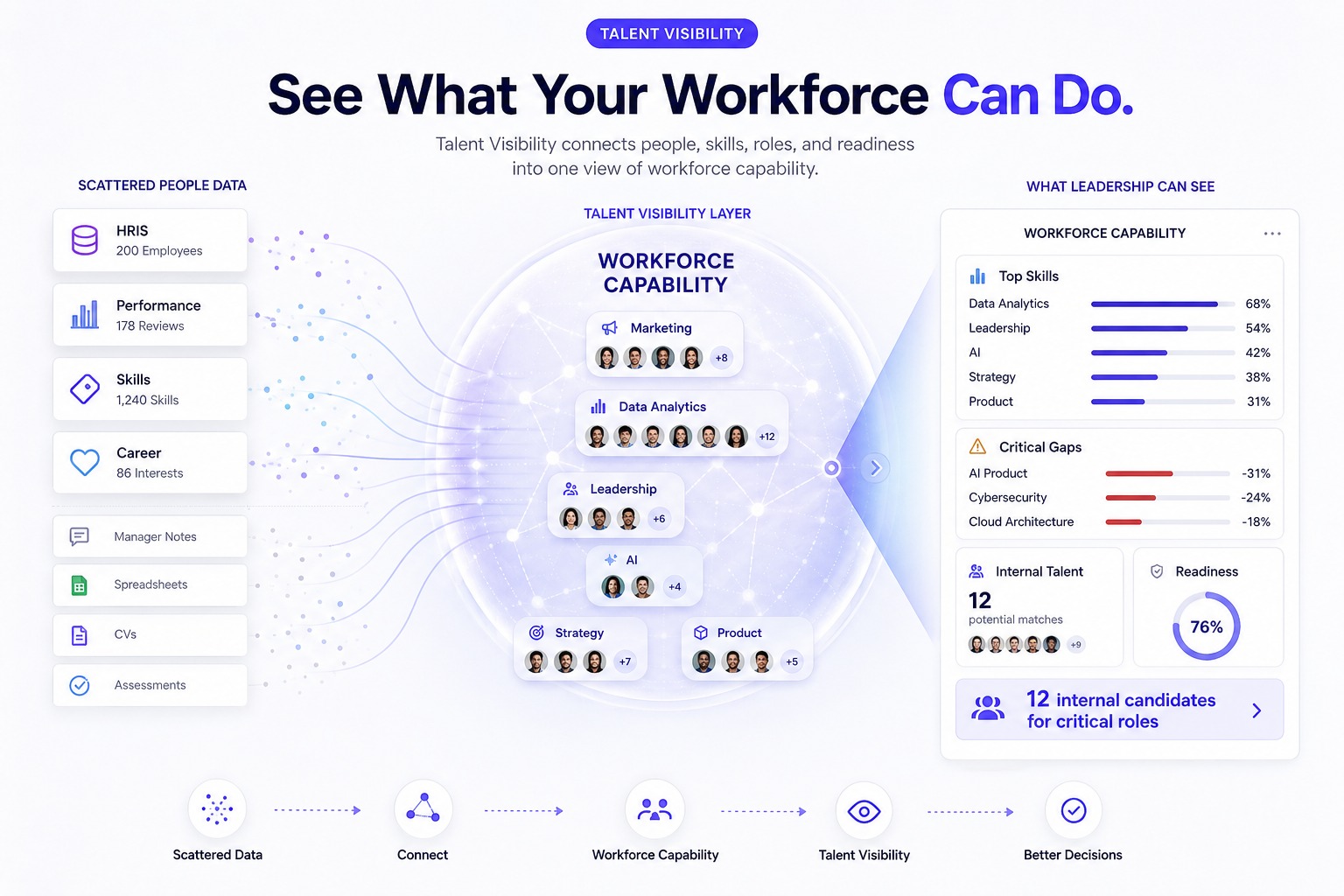
Talent Visibility is the ability to see and understand workforce capability systematically — from skills, experience, and performance to potential, readiness, and career interests.
Put simply:
Employee data tells you who is here. Talent Visibility tells you what your workforce can do.
Why Do Organizations Lack Talent Visibility?
The problem usually isn’t that companies have no data.
It is that the data is scattered across too many places.
For example:
HRIS
  ↓
Job title + Team + Tenure

Performance System
  ↓
Goals + Ratings

Manager
  ↓
"John is really good at this."

CV
  ↓
Past experience

Learning System
  ↓
Courses + Certifications

Employee
  ↓
Skills + Career interests
Each source contains part of the talent picture.
But there is no unified view.
So when the organization needs to find talent, it often goes back to:
Manager memory.
“I think someone on my team is good at this.”
“I remember someone worked on a similar project.”
“Let me ask the other managers.”
That’s not Talent Visibility.
That’s talent discovery by memory.
What Does Talent Visibility Actually Show?
Talent Visibility is more than knowing the employee count.
A useful workforce view should answer at least five questions.
1. Who?
Who is in the organization?
- Employee
- Team
- Role
- Level
2. What can they do?
What skills do they have?
- Skills
- Proficiency
- Experience
- Certifications
3. What have they done?
Where have they applied those capabilities?
- Projects
- Previous roles
- Relevant experience
- Achievements
4. What could they do next?
Where could they grow?
- Career path
- Potential
- Readiness
- Development needs
5. Where does the business need them?
Where could their capability create value?
- Critical roles
- Projects
- Skill gaps
- Strategic priorities
This is where workforce data starts becoming Talent Intelligence.
Talent Visibility vs. Employee Visibility
These concepts are easy to confuse.
| Employee Visibility | Talent Visibility | |
|---|---|---|
| Focus | Workforce structure | Workforce capability |
| Core question | ”Who is where?" | "Who can do what?” |
| Data | Role, team, tenure | Skills, experience, potential, readiness |
| View | Organizational | Capability-based |
| Use case | HR operations | Talent & workforce decisions |
For example:
Employee Visibility might tell you:
Nguyen A — Senior Marketing Manager — Marketing Team
Talent Visibility might tell you:
Nguyen A — Growth Marketing + Data Analytics + CRM — Advanced — 92% fit with Growth Project
That is a significant difference.
Talent Visibility and Skills Intelligence
Skills Intelligence is an important component of Talent Visibility.
Think of it as:
Employee Data
      ↓
Skills Data
      ↓
Skills Intelligence
      ↓
Talent Visibility
      ↓
Talent Decisions
Skills Intelligence helps organizations understand:
What skills exist across the workforce?
Talent Visibility expands that question:
Who has those skills, where are they, where could they be used, and how could they develop?
The two concepts therefore complement each other.
What Can Talent Visibility Help Organizations Do?
1. Find Internal Talent Faster
A new role opens.
The traditional approach:
Post job → wait for applications.
A Talent Visibility approach:
Search workforce → identify relevant skills → review fit → engage internal talent.
For example:
New Role
   ↓
Required Skills
   ↓
Internal Workforce
   ↓
12 Potential Matches
   ↓
3 Strong Candidates
This creates the foundation for an Internal Talent Marketplace.
2. Identify Skill Gaps
Talent Visibility doesn’t just tell you:
“What skills do we have?”
It also helps answer:
“What skills are we missing?”
For example:
Required Capability

AI Product Management
██████████ 100%

Current Capability
██████░░░░ 60%

Gap
████░░░░░░ 40%
The organization can then decide whether to:
- Hire
- Build
- Buy
- Borrow
- Move talent internally
Instead of automatically defaulting to:
Hire.
3. Support Succession Planning
One of the hardest questions in succession planning is:
Who could step into this critical role?
Without Talent Visibility, the answer often depends on:
- Manager recommendations
- Tenure
- Performance
- Personal knowledge
With capability data, organizations can start with:
Critical Role
      ↓
Required Skills
      ↓
Internal Talent Pool
      ↓
Potential Successors
      ↓
Readiness + Gaps
This makes succession planning more concrete and evidence-based.
4. Support Career Development
Talent Visibility isn’t only useful for HR.
It can also help employees understand:
Where am I today?
What skills do I have?
Where could I go next?
What am I missing to get there?
For example:
Current Role
Marketing Manager

Current Skills
████████░░

Target Role
Head of Marketing

Skill Gap
Strategic Planning
People Leadership
Financial Management
Career development becomes a more concrete roadmap instead of:
“You should work on your leadership skills.”
5. Support Workforce Planning
Workforce planning is not only about headcount.
An organization can have enough people and still lack critical capability.
For example:
Headcount = 200
But:
AI skills = 5 employees
If next year’s strategy depends heavily on AI, the workforce is clearly not ready.
Talent Visibility helps leadership see:
Current Workforce
↓
Current Capability
↓
Required Capability
↓
Readiness Gap
This informs decisions around:
- Hiring
- Reskilling
- Upskilling
- Redeployment
- Restructuring
What Happens When Organizations Lack Talent Visibility?
1. External hiring becomes the default
If you can’t see internal talent, you hire externally.
2. Managers become the “database”
Finding talent requires asking individual managers.
3. Internal mobility stays low
Employees don’t know what opportunities exist, and HR doesn’t know who could be a fit.
4. Succession planning relies on opinion
There may be a successor list, but no clear view of actual readiness.
5. Learning becomes disconnected from business needs
The organization invests in training without knowing which capabilities it actually needs.
This is the cost of invisibility.
Talent Visibility Does Not Mean Tracking Employees
This is an important distinction.
Talent Visibility should not mean:
“Collect everything about employees.”
The goal is:
Make relevant capability visible for better decisions.
The data needs a purpose.
For example:
- Skills → understand capability
- Experience → understand evidence
- Career interests → support mobility
- Readiness → support succession
- Skill gaps → support development
Good Talent Visibility isn’t about more employee data.
It’s about:
Better-connected talent data.
How to Build Talent Visibility
You don’t need to start with a massive system.
Step 1: Map your workforce
Start with:
- People
- Roles
- Teams
- Levels
Step 2: Build a Skills Inventory
Identify the skills that exist across your workforce.
Learn more about Skills Inventory.
Step 3: Map skills to roles
Define:
What skills does this role require?
At what proficiency level?
Step 4: Add career and readiness data
Include:
- Career interests
- Development goals
- Readiness
- Potential
Step 5: Connect the data
Once the data is connected:
People
  ↓
Skills
  ↓
Roles
  ↓
Opportunities
  ↓
Business Needs
the organization begins to develop a true Talent Visibility layer.
Talent Visibility Is a Foundation for Talent Intelligence
Talent Intelligence needs data.
But disconnected data doesn’t create intelligence.
Think of it as:
Workforce Data
      ↓
Skills Data
      ↓
Talent Visibility
      ↓
Talent Intelligence
      ↓
Talent Decisions
Talent Visibility is the layer that helps organizations understand workforce capability before making decisions.
Without knowing what capability already exists, it is difficult to decide:
What should we build?
What should we buy?
Who should we move?
Who should we develop?
Who should we retain?
Who should we hire?
From Talent Visibility to Talent Intelligence
This is an important shift.
Traditional HR question:
“Who works here?”
Talent Visibility question:
“What can our people do?”
Talent Intelligence question:
“What does our workforce capability mean for the business?”
And ultimately:
“What should we do next?”
That is why Talent Visibility isn’t simply another reporting feature.
It is a foundation for how organizations make talent decisions.
Talent Visibility and SkillMAP
SkillMAP helps organizations build a unified view of workforce capability.
Instead of talent data being scattered across HRIS, spreadsheets, performance reviews, and manager knowledge, SkillMAP connects data such as:
- Workforce skills
- Skill gaps
- Role requirements
- Career readiness
- Internal talent
- Workforce insights
The goal is to help HR and leadership move from:
“How many people do we have?”
to:
“What capabilities do we have — and how can we use them?”
👉 Explore SkillMAP Demo with sample data
FAQs
What is Talent Visibility?
Talent Visibility is the ability to see and understand workforce capability systematically, including skills, experience, potential, readiness, and career interests.
How is Talent Visibility different from Employee Visibility?
Employee Visibility shows who employees are and where they sit in the organization. Talent Visibility goes deeper into capability and their potential current and future contribution.
Why is Talent Visibility important?
Talent Visibility helps organizations identify internal talent, understand skill gaps, support succession, career development, and workforce planning.
Is Talent Visibility the same as Skills Intelligence?
Not exactly. Skills Intelligence focuses on understanding and analyzing skills data. Talent Visibility is broader, connecting skills with people, roles, experience, readiness, and opportunities.
How can organizations improve Talent Visibility?
Organizations can start with workforce mapping, build a Skills Inventory, standardize role requirements, and connect skills with career, readiness, and business needs.
Frequently Asked Questions
What is Talent Visibility?
Talent Visibility is the ability to see and understand workforce capability, including skills, experience, potential, readiness, and career interests.
How is Talent Visibility different from Employee Visibility?
Employee Visibility shows who employees are and where they sit in the organization. Talent Visibility goes deeper into capability, skills, potential, and future contribution.
Why is Talent Visibility important?
Talent Visibility helps organizations identify internal talent, understand skill gaps, support succession and workforce planning, and reduce reliance on individual manager knowledge.
How can organizations improve Talent Visibility?
Organizations can start by building a workforce skills inventory, standardizing role requirements, and connecting skills, experience, readiness, and career data.