Quick Takeaways
Talent Management focuses on managing people processes, while Talent Intelligence transforms workforce data into insights that support strategic talent decisions.
- Talent Management manages HR processes.
- Talent Intelligence supports better decisions using workforce data.
- Talent Intelligence complements rather than replaces Talent Management.
- Organizations need both to build an agile workforce.
Talent Management vs Talent Intelligence
For years, organizations have invested in Talent Management.
They recruit employees, conduct performance reviews, deliver training, and build succession plans.
Yet many leaders still struggle to answer simple questions.
- Which critical skills are missing today?
- Who is ready for promotion?
- Where are the biggest workforce risks?
- Which employees should be developed for future roles?
The challenge isn’t managing talent.
The challenge is seeing talent clearly enough to make better decisions.
That’s where Talent Intelligence comes in.
What Is Talent Management?
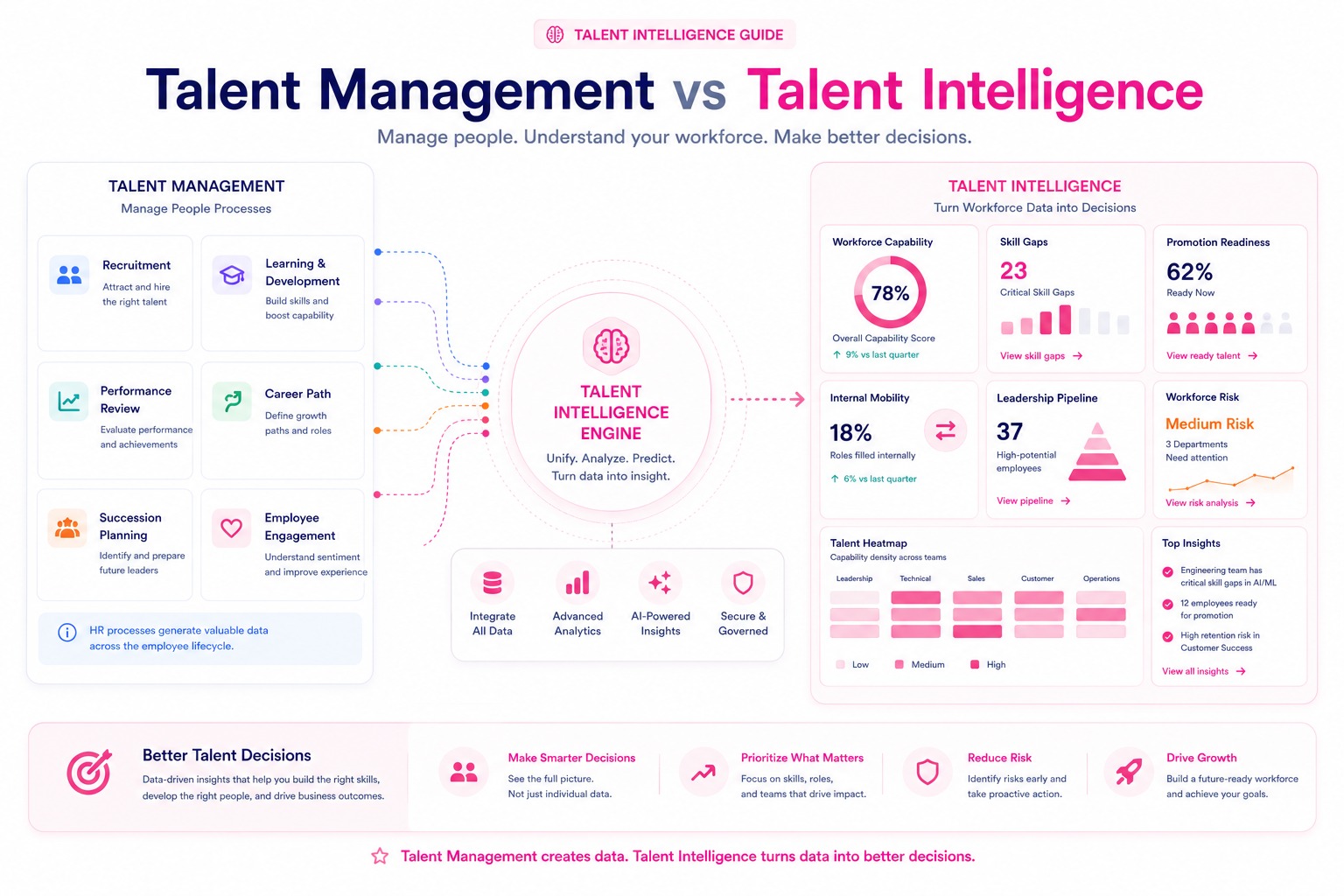
Talent Management is the collection of HR processes used to attract, develop, retain, and grow employees.
Typical Talent Management activities include:
- Recruitment
- Onboarding
- Performance Management
- Learning & Development
- Career Development
- Succession Planning
- Employee Engagement
Talent Management focuses on executing people processes effectively.
What Is Talent Intelligence?
Talent Intelligence is the practice of collecting, connecting, and analyzing workforce data to support better talent decisions.
Instead of asking “What HR process should we run?”
Talent Intelligence asks:
- What capabilities do we have?
- What skills are we missing?
- Who has the highest potential?
- Where should we invest in development?
- Which workforce risks require attention?
Talent Intelligence transforms workforce data into business insight.
Talent Management vs Talent Intelligence
| Talent Management | Talent Intelligence |
|---|---|
| Focuses on HR processes | Focuses on workforce insights |
| Executes talent programs | Supports strategic decisions |
| Manages employees | Understands workforce capability |
| Tracks activities | Connects workforce data |
| Looks at individual processes | Creates an organization-wide view |
| Answers “What should HR do?” | Answers “What should the business decide?” |
A simple way to think about it:
Talent Management runs the process.
Talent Intelligence guides the decision.
Does Talent Intelligence Replace Talent Management?
No.
Talent Intelligence is not another HR process.
It is a decision layer built on top of existing Talent Management activities.
Without Talent Management, there is little workforce data to analyze.
Without Talent Intelligence, that data often remains disconnected across multiple systems.
The two are strongest when used together.
How They Work Together
Modern organizations increasingly follow this approach:
- Build a Competency Framework.
- Assess employee capabilities.
- Manage development through Talent Management.
- Analyze workforce capability using Talent Intelligence.
- Improve workforce planning and internal mobility.
Talent Management generates workforce activities.
Talent Intelligence helps leaders understand their impact.
Why Talent Intelligence Matters
Traditional Talent Management answers questions such as:
- Did employees complete training?
- Was the performance review completed?
- Was the succession plan documented?
Talent Intelligence goes further.
It helps organizations answer:
- Are employees actually becoming more capable?
- Which teams are falling behind?
- Which critical skills are disappearing?
- Where should development budgets be invested?
- Who is ready for future leadership roles?
This shift moves HR from administration to strategic workforce planning.
Common Misconceptions
Many organizations believe Talent Intelligence is simply another HR system.
It isn’t.
Talent Intelligence does not replace:
- HRIS
- ATS
- LMS
- Performance Management
Instead, it connects data from these systems to provide a unified view of workforce capability.
Conclusion
Talent Management and Talent Intelligence serve different purposes.
Talent Management ensures HR processes run effectively.
Talent Intelligence ensures those processes lead to better business decisions.
As organizations face rapid skill changes and increasing workforce complexity, managing talent is no longer enough.
Organizations also need to understand their workforce deeply enough to prepare for the future.
That is the role of Talent Intelligence.
Frequently Asked Questions
What is the difference between Talent Management and Talent Intelligence?
Talent Management focuses on HR processes, while Talent Intelligence analyzes workforce data to support strategic decisions.
Can Talent Intelligence replace Talent Management?
No. Talent Intelligence complements Talent Management by providing insights from workforce data.
Why is Talent Intelligence important?
It helps organizations identify capability gaps, improve workforce planning, support internal mobility, and make better talent decisions.
Do organizations need both?
Yes. Talent Management executes people programs, while Talent Intelligence helps leaders understand whether those programs are creating the workforce the business needs.
Related Articles
- What Is Talent Intelligence?
- Talent Intelligence Platform
- HRIS vs Talent Intelligence Platform
- Competency Management
- Workforce Analytics
Explore what’s possible with SkillMAP
Frequently Asked Questions
What is the difference between Talent Management and Talent Intelligence?
Talent Management focuses on HR processes, while Talent Intelligence analyzes workforce data to support strategic decisions.
Can Talent Intelligence replace Talent Management?
No. Talent Intelligence complements Talent Management by providing insights from workforce data.
Why is Talent Intelligence becoming important?
It helps organizations identify capability gaps, improve workforce planning, support internal mobility, and make better talent decisions.
Do organizations need both?
Yes. Talent Management executes people programs, while Talent Intelligence helps leaders understand whether those programs are creating the workforce the business needs.