Quick Takeaways
Skills Management Software helps organizations understand workforce capabilities, identify skill gaps, and support workforce planning. The right solution depends on company size, business complexity, and talent strategy.
- Skills Management Software is more than a skills database.
- Enterprise platforms may be too complex for many SMEs.
- A Skill Matrix and Competency Framework should be the foundation.
- Talent Intelligence helps turn skill data into better decisions.
Skills Management Software
As organizations grow, spreadsheets quickly become difficult to maintain.
Managers update skills manually.
HR struggles to understand capability gaps.
Leadership has little visibility into workforce readiness.
That’s why many organizations start looking for Skills Management Software.
But here’s the problem.
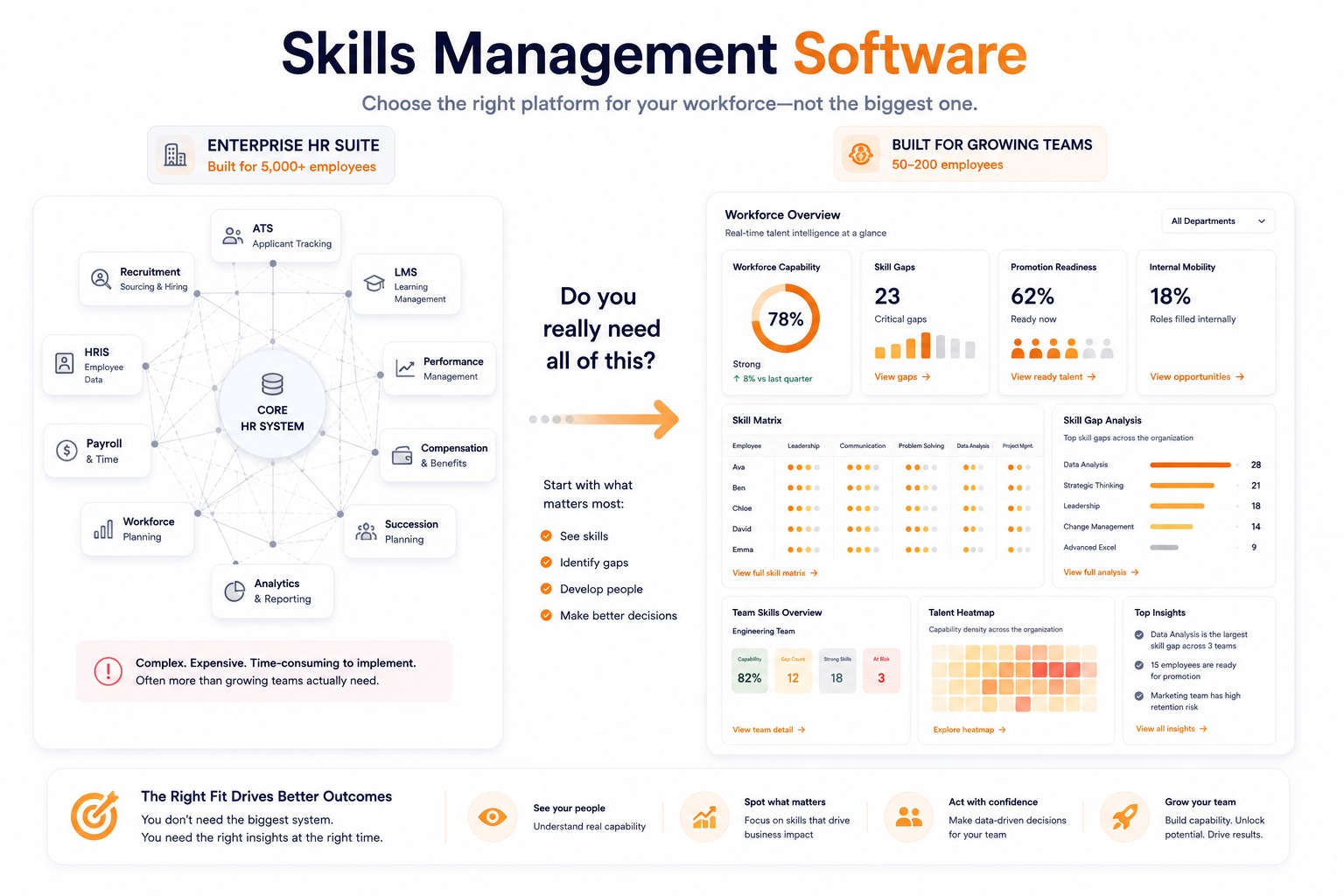
Many of the best-known platforms were designed for global enterprises—not companies with 50 to 200 employees.
Choosing software that’s too complex can create more work than value.
This guide explains what Skills Management Software is, how different solutions compare, and what growing businesses should consider before investing.
What Is Skills Management Software?
Skills Management Software helps organizations collect, organize, assess, and visualize employee skills.
Instead of maintaining disconnected spreadsheets, companies can build a centralized view of workforce capability.
Typical use cases include:
- Skills inventory
- Employee Skills Assessment
- Skill Matrix
- Skill gap analysis
- Internal Mobility
- Workforce Planning
- Succession Planning
The goal isn’t simply storing skill data.
It’s helping organizations make better talent decisions.
Different Types of Skills Management Software
Not every solution is built for the same purpose.
Enterprise Talent Platforms
Examples include platforms such as:
- Gloat
- Cornerstone
- Eightfold AI
These products often include:
- AI talent marketplace
- Workforce planning
- Internal mobility
- Career development
- Learning recommendations
- Advanced analytics
They are powerful—but also expensive and complex to implement.
For large enterprises, that investment may make sense.
For many SMEs, it often doesn’t.
Learning Platforms
Many LMS platforms also include basic skills tracking.
Their primary focus is learning administration rather than workforce visibility.
While useful for training management, they rarely provide a complete picture of organizational capability.
Talent Intelligence Platforms
A Talent Intelligence Platform focuses on understanding workforce capability.
Rather than replacing existing HR systems, it connects competency data, skill assessments, and workforce insights.
This enables organizations to answer questions such as:
- Which critical skills are missing?
- Who is ready for promotion?
- Which teams need development?
- Where are future capability risks?
What Features Should You Look For?
When evaluating Skills Management Software, prioritize capabilities that support decision-making—not just data collection.
Essential features include:
- Competency Framework management
- Employee Skills Assessment
- Skill Matrix visualization
- Skill Gap Analysis
- Workforce capability dashboards
- Career Path support
- Internal Mobility insights
- Reporting and analytics
The software should help managers understand workforce capability at a glance.
Do SMEs Need Enterprise Platforms?
Not necessarily.
Many enterprise suites are designed for organizations with thousands of employees.
They often require:
- Long implementation projects
- Extensive customization
- Dedicated HRIS teams
- Significant licensing costs
For organizations with 50–200 employees, simplicity often creates more value than complexity.
Instead of deploying every HR module available, many SMEs benefit from starting with:
- A Competency Framework
- Employee Skills Assessment
- A live Skill Matrix
- Talent Intelligence dashboards
These provide immediate visibility without overwhelming the organization.
How to Choose the Right Skills Management Software
Before evaluating vendors, ask yourself four questions.
1. Do we have a Competency Framework?
Without clear competency definitions, software cannot produce meaningful insights.
2. Can managers easily assess employee skills?
The assessment process should be simple enough to encourage consistent adoption.
3. Does the platform visualize workforce capability?
Raw data isn’t enough.
Decision-makers need dashboards, Skill Matrices, and organizational insights.
4. Does it support future talent decisions?
Good software should support:
- Promotions
- Succession Planning
- Internal Mobility
- Workforce Planning
Not simply record employee information.
Why Talent Intelligence Matters
Managing skills is only the first step.
The real value comes from understanding what those skills mean for the business.
Talent Intelligence connects assessment data with organizational context to answer questions such as:
- Are we ready for future growth?
- Which capabilities are becoming critical?
- Where should development budgets be invested?
- Which employees have the highest potential?
This transforms Skills Management Software from an HR tool into a strategic decision platform.
Conclusion
Skills Management Software should help organizations understand—not just record—employee skills.
For many SMEs, starting with an enterprise platform is unnecessary.
A stronger approach is to build:
- A Competency Framework
- Employee Skills Assessments
- A live Skill Matrix
- Talent Intelligence dashboards
These foundations provide the visibility needed to develop people, reduce capability gaps, and make better workforce decisions as the business grows.
Frequently Asked Questions
What is Skills Management Software?
Skills Management Software helps organizations assess, manage, and visualize employee skills to support workforce planning and talent development.
Do SMEs need enterprise Skills Management Software?
Not always. Many SMEs benefit from simpler platforms that focus on competency management, Skill Matrices, and Talent Intelligence.
What features are most important?
Look for Competency Framework management, Employee Skills Assessment, Skill Matrix visualization, Skill Gap Analysis, and reporting dashboards.
How is Skills Management Software different from an HRIS?
An HRIS manages employee records and HR operations. Skills Management Software focuses on workforce capability and skills visibility.
Related Articles
- Competency Management Software
- Employee Skills Assessment
- Skill Matrix
- Talent Intelligence Platform
- HRIS vs Talent Intelligence Platform
Explore what’s possible with SkillMAP
Frequently Asked Questions
What is Skills Management Software?
Skills Management Software helps organizations assess, manage, and visualize employee skills to support workforce planning and talent development.
Do SMEs need enterprise Skills Management Software?
Not always. Many SMEs benefit from simpler platforms that focus on competency management, Skill Matrices, and Talent Intelligence.
What features are most important?
Look for Competency Framework management, Employee Skills Assessment, Skill Matrix visualization, Skill Gap Analysis, and reporting dashboards.
How is Skills Management Software different from an HRIS?
An HRIS manages employee records and HR operations. Skills Management Software focuses on workforce capability and skills visibility.